
Lauren Baskin
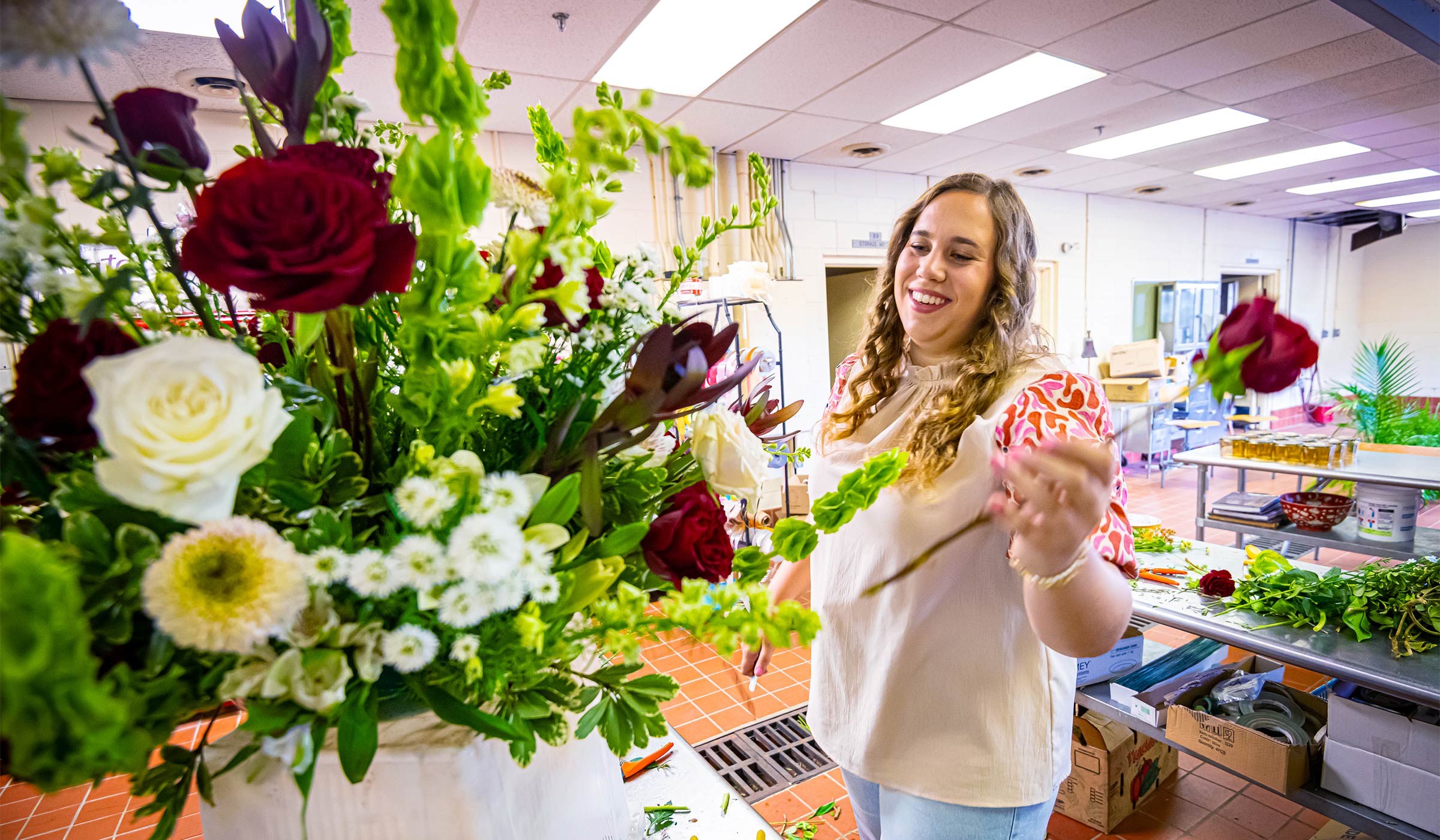
Horticulture master’s student Lauren Baskin knows that most people value flowers as an important way to mark special occasions, including some of the most heightened emotional times of life—births, weddings and funerals.
Manager of MSU’s University Florist, she got an early education in horticulture from her father on a farm in western Tennessee. Baskin’s mother, a beekeeper, taught her that flowers are essential to honeybee health and nutrition. Her grandmother, a florist, also played a pivotal role in shaping Baskin’s path and still helps her design wedding arrangements today.
“Some people will call and say they have to have a certain flower because it means so much to them, and others will say they can’t stand another flower because the scent brings up negative memories,” Baskin said.
Before graduate school, she also earned her bachelor’s degree in horticulture with a focus in floral management from MSU’s College of Agriculture and Life Sciences and its Department of Plant and Soil Sciences.
“I’ve wanted to attend MSU since seventh grade, when my class was assigned a college research project,” she said. “When it was time to apply, I discovered MSU had a floral design degree program, and it felt like fate.”
Studying under her advisor Coleman Etheredge, an associate professor in the department, Baskin specializes in cut flower production and floristry canvas. She has taught classes in basic floral design and wedding floral design, and her thesis focuses on the post-harvest life of zinnias. She is also a member of MSU’s chapter of the Student American Institute of Floral Design, or SAIFD, and already has earned her Certified Floral Designer accreditation, a prestigious professional credential requiring courses and an exam.
After she graduates this May, Baskin plans to return home to work on the family farm and focus on growing her wedding floral business and cut-flower farm startup.
“Wedding floral is a booming industry. We don’t often think about where our flowers come from, but most are imported from South America,” she said. “Growing flowers locally has so many benefits, from reducing the carbon footprint to boosting local ecology and providing food for honeybees.”
For the moment, Baskin is focusing on finishing her degree program and seeing the impact of her arrangements.
“I love the special events side of florals,” she said. “That’s where my passion lies. There’s just something about watching someone react when they see that bouquet you made for them. It’s a magical feeling.”