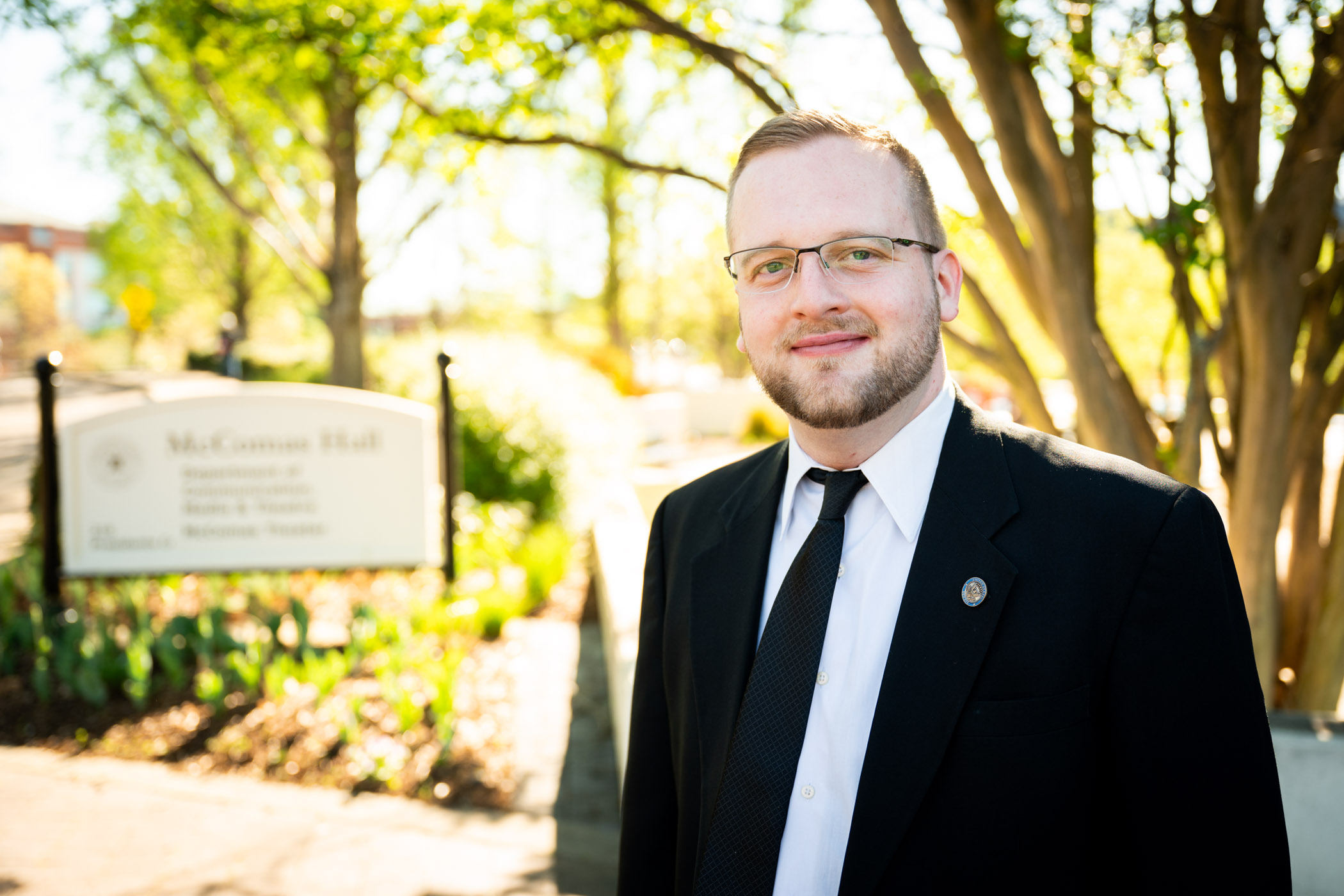
Gil Carter
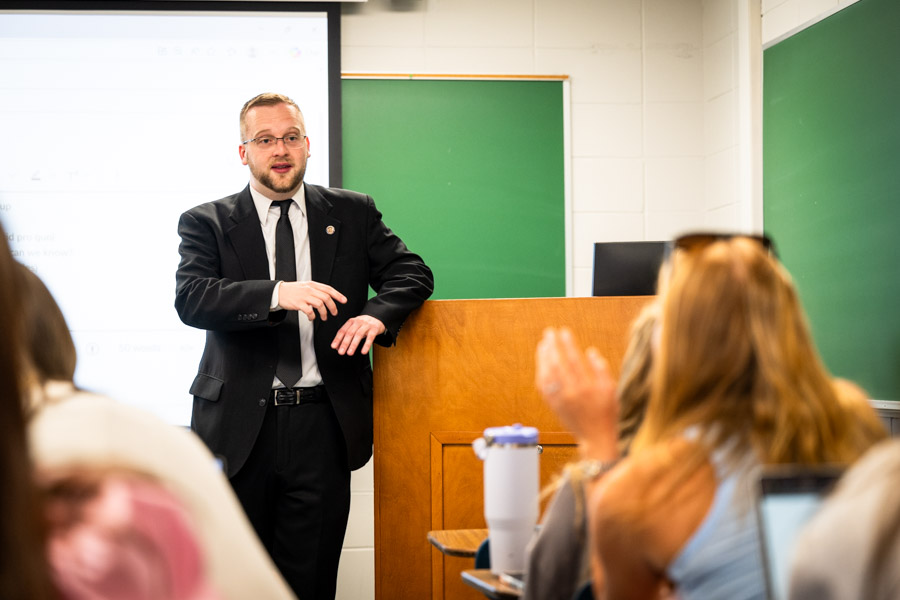
No matter what, Gil Carter was always going to find a career in education.
“When people like politics, there’s the old saying that they have been ‘bitten by the bug.’ I was bitten at a young age,” laughed Carter, an assistant professor in Mississippi State University’s Department of Communication, Media and Theatre.
Carter’s early fascination grew at the intersection of two lifelong influences: education and politics. A native of Killen, Alabama, he comes from a family of educators, including both parents, his siblings and a grandmother who was a professor of secondary education.
“I always wanted to be a professor,” he said. “In middle school, I even had a text signature that said, ‘Gil Carter, Future Ph.D.’ I grew up knowing you could study what you loved and make a career out of it.”
At the same time, politics was never far from reach. Carter’s late grandfather served nine terms in the Alabama State Legislature, and some of Carter’s earliest memories involve microphones, campaign events and public speaking.
“One of my first speeches was roasting my grandfather at a benefit dinner when I was seven,” he said. “There’s even a picture of me as a baby, grabbing the microphone on the State House floor while he held me. That photo is on my desk today.”
Those experiences carried into college and beyond. Carter worked on political campaigns, eventually serving as district director for a successful Alabama State Senate reelection campaign.
“I realized I didn’t have to choose between education and politics,” he said. “I could combine them.”
He earned a bachelor’s degree from the University of North Alabama and both his master’s and doctoral degrees from the University of Alabama, focusing on political communication, rhetoric and persuasion. He taught throughout graduate school, earning UA’s Outstanding Teaching by a Doctoral Student award.
Before arriving at MSU in August 2024, Carter served as an assistant instructional professor and director of debate at the University of Florida.
“When I saw the position at Mississippi State, people kept sending it to me saying, ‘This is your CV in a job description,’” he said. “I’m honored to be here. I feel at home.”
Carter teaches elements of persuasion, political communication and words that changed the world, helping students understand how communication shapes democracy. His passion is rooted in a pivotal moment as a high school student when he attended Boys Nation in Washington, D.C. and was invited to meet the president.
“Meeting President Obama and walking the halls of the U.S. Senate changed everything for me,” he said. “That’s when I realized I needed to study the Senate.”
Now, Carter frequently returns to the nation’s capital, immersing himself in the environments he studies.
“When I was invited by a staff member I know to the White House to tour the West Wing in July 2025, 10 years to the week since I first visited there, I was overwhelmed seeing the Oval Office,” Carter said. “I’ve seen life-size replicas in museums, but seeing the real thing made me think, ‘Wow, it actually exists!’ It’s not just a place you see on TV.
“I often talk with my students about how understanding place is key to understanding rhetoric,” he continued. “When you stand in those rooms, you better understand the communication happening within them.”
That perspective informs both his teaching and research.
“My work is one way I participate in democracy,” Carter said. “I help students craft messages, think critically and engage in political discourse.”
He said familiarity can sometimes lead Americans to disengage.
“We can become so accustomed to democracy that we tune out political messages,” Carter said. “But democracy is government by and of the people, so ‘we the people’ have a responsibility to engage. We are obliged to participate in democracy.”