
MSU, Mississippi First report details state’s investment in young children
Contact: Emile Pennington
STARKVILLE, Miss.—A new report from Mississippi State’s Systems Change Lab and Mississippi First provides a comprehensive look at how state-level funding and policy decisions affect programs serving more than 200,000 children under age 5 across the Magnolia State.
Supported by the W.K. Kellogg Foundation, the third edition of “Investing in Our Future: How Mississippi Supports Young Children” outlines these investments and performance metrics across education, healthcare, nutrition, childcare, family support and child welfare.
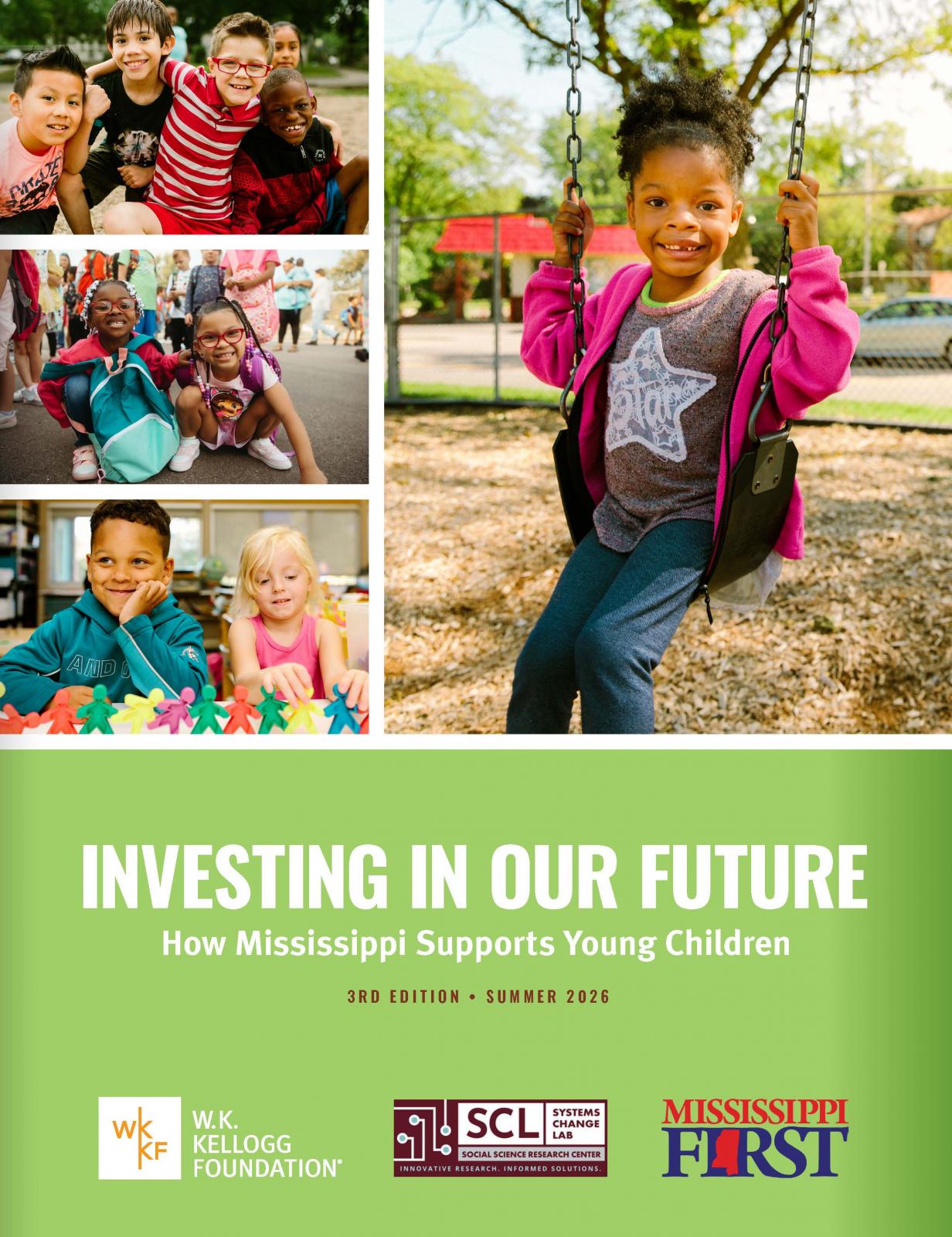
Assembled by the SCL within MSU’s Social Science Research Center, the report compiles public agency data into an accessible resource designed for policymakers, educators and community leaders.
“Every child deserves the opportunity to thrive. Building that future begins with understanding what is working, where progress is being made and where more work remains,” said Todd Klunk, W. K. Kellogg Foundation senior program officer.
Gina Rico Mendez, MSU faculty lead of the SCL and an associate research professor, emphasized the importance of presenting objective information to inform policy considerations and increase understanding of Mississippi’s early childhood system.
“Compiling data sounds like a simple task. You go into a data system and pull the numbers,” she said. “In practice, early childhood programs are administered across many agencies, so we went to each one separately. Our agency partners were generous with their time and expertise, and together we are building a data infrastructure that can serve the whole early childhood community in Mississippi.”
This year, the SCL made several enhancements to the publication, including a five-year data series that traces investments and program reach from Fiscal Year 2021 through FY 2025, filling in gaps from prior editions to build a more complete picture of how Mississippi’s commitments to young children have changed over time.
In addition, a new methods section and reader’s guide explain how data were collected, where gaps exist and how to use this publication—making the report more accessible and transparent for a wide range of readers.
Micayla Tatum, director of early childhood policy at Mississippi First, recognized the importance of creating a more complete picture of Mississippi’s early childhood systems.
“The additions matter because this report is only as valuable as its use,” she said. “With clearer insight into the data, our hope is that it doesn’t just sit on a shelf, but becomes a tool for educators, providers and leaders across Mississippi.”
Rico Mendez said, “This report exists because of our agency partners. Staff across state agencies and programs took the time to locate records, explain how their systems work and answer follow-up questions, often on top of full workloads. We are grateful to them and to Mississippi First and the W.K. Kellogg Foundation for their partnership throughout.”
Individuals interested in learning more about the report are encouraged to register for a free webinar on Tuesday, Sept. 29. During the webinar, project leaders will discuss the report’s key findings. Register at https://bit.ly/4jfKHT5.
The Systems Change Lab is part of MSU’s Social Science Research Center.
Mississippi State University is taking care of what matters.