
MSU faculty, students earn international honor for wood science innovation
Contact: Vanessa Beeson
STARKVILLE, Miss.—A Mississippi State University research project born in the classroom and expanded through hands-on collaboration is earning international recognition for advancing wood science.
Faculty and students in MSU’s Department of Sustainable Bioproducts received the George Marra Award from the Society of Wood Science and Technology for their peer-reviewed publication investigating how wood grain angle influences structural performance. This is the second consecutive year for scientists in MSU’s Forest and Wildlife Research Center to receive the recognition.
The team compared the century-old Hankinson formula, which predicts strength based on grain angle direction, with real-time acoustic emission data gathered during compression testing to better understand how damage forms inside the wood.
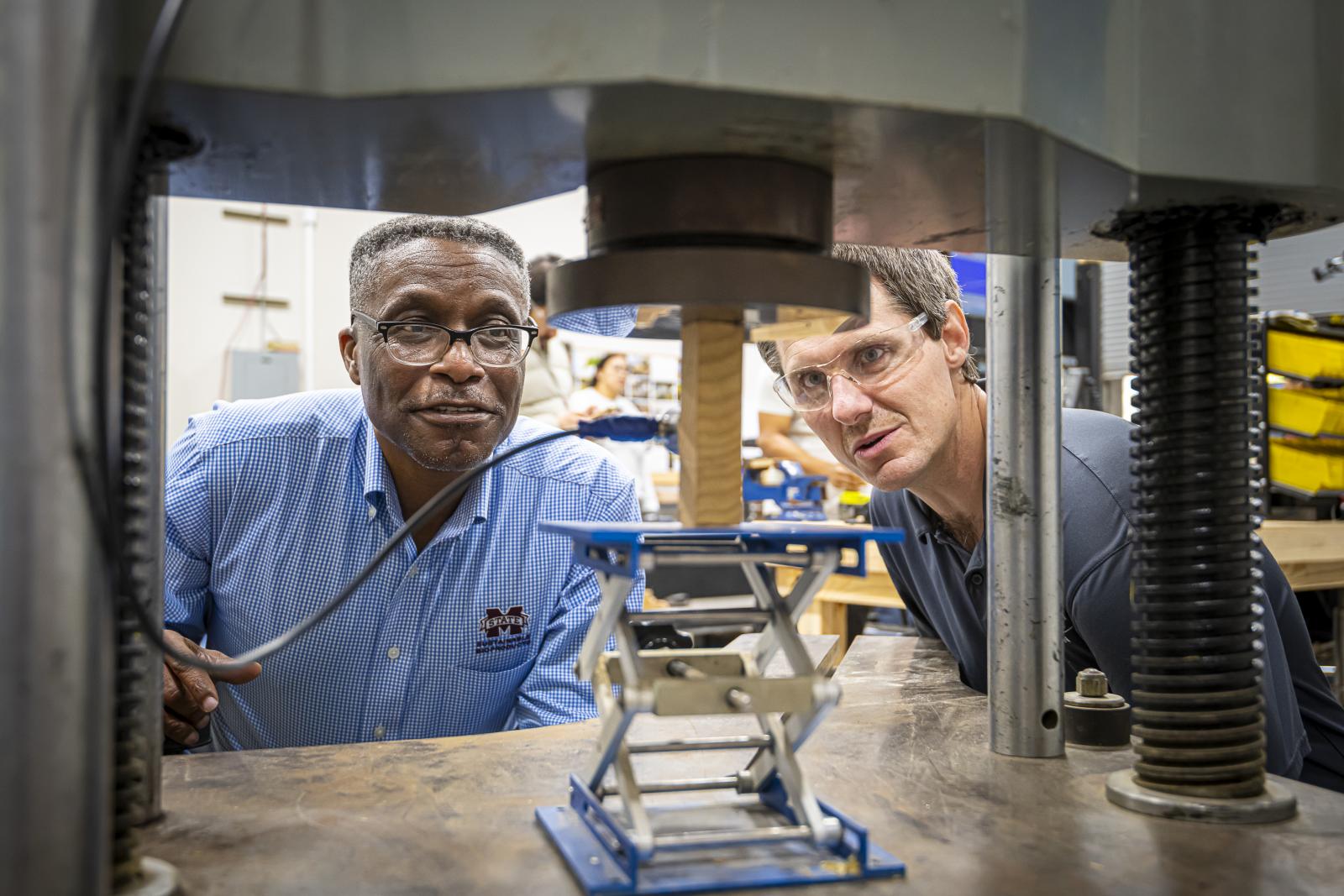
The work originated in the College of Forest Resources’ Advanced Wood Mechanics course, taught by Jilei Zhang, the university’s Warren S. Thompson Professor of Wood Science and Technology, who has emphasized inquiry-driven learning throughout his career.
“We found a knowledge gap. Everyone knows wood grain affects strength, but no one had completed a comprehensive study connecting grain angle and acoustic emission from 0-90 degrees,” Zhang said.
Students tested southern yellow pine wood samples at varying grain orientations, while sensors captured acoustic emission signatures linked to microcracking inside the material. Their findings showed the historic Hankinson model remains remarkably accurate compared to today’s advanced-sensing tools. The research also establishes new baseline data that can support non-destructive evaluation methods used throughout the wood products industry to enhance quality and safety.
Assistant Professor Franklin Quin, who led the laboratory instruction, said the recognition reinforces the FWRC’s strength.
“Professionally, it shows you can contribute to the overall body of knowledge, take a concept, formalize it and deliver something valuable,” Quin said.
Extension Associate III Edward D. Entsminger helped drive the project forward after finishing the upper-level graduate course as a doctoral student.
“What surprised us most was even after more than 100 years, the original Hankinson formula still aligns very closely with modern acoustic emission technology,” said Entsminger, who graduated with a doctoral degree in forest resources in 2022.
The achievement, he said, reflects a shared commitment to excellence.
“This is one of the highest awards in the Society of Wood Science and Technology,” Entsminger said. “To see a class project evolve into an award-winning publication with such a great team is incredibly humbling and a huge honor.”
Collaborators include former students Rajan Adhikari, who earned a master’s and is a product engineer at Weyerhaeuser, and Samuel Ayanleye, who earned a doctorate and is a staff engineer with The Engineered Wood Association. Wengang Hu, an associate professor at Nanjing Forestry University, also contributed to the work.
For more on MSU’s Department of Sustainable Bioproducts in the College of Forest Resources, visit www.bioproducts.msstate.edu.
Mississippi State University is taking care of what matters. Learn more at www.msstate.edu.