
Endangered sea turtles receive critical imaging at MSU’s College of Veterinary Medicine
Contact: Wade Leonard
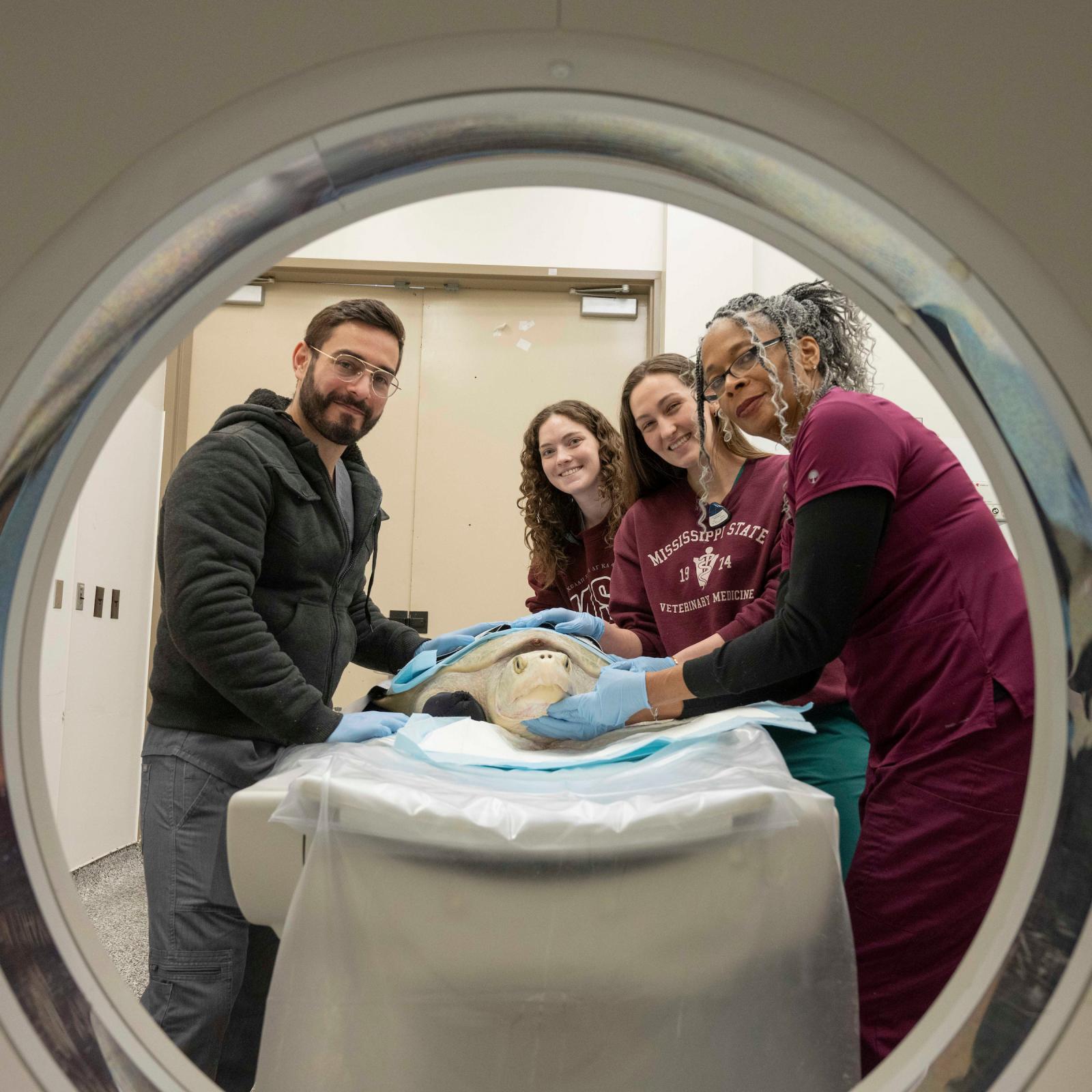
STARKVILLE, Miss.—Two endangered sea turtles receiving long-term medical care on the Mississippi Gulf Coast spent time last week at Mississippi State University’s College of Veterinary Medicine for advanced diagnostic imaging that will guide their ongoing treatment.
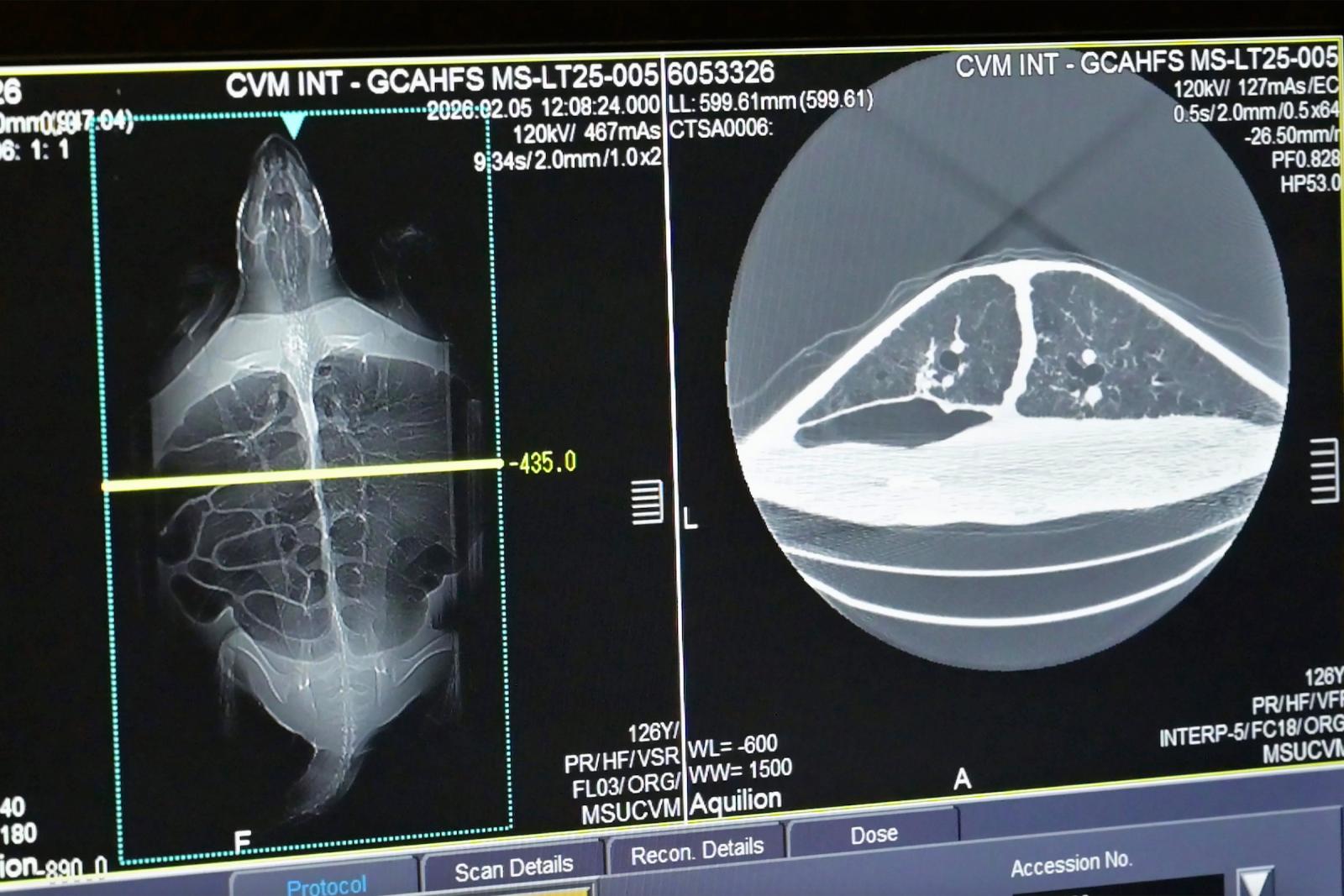
Alfonzo, a sub-adult Green sea turtle, and Sawyer, an adult male Kemp’s ridley sea turtle, were transported to MSU CVM for computed tomography scans performed by the college’s radiology team led by Assistant Clinical Professor Dr. Tom Campbell.
The turtles were originally rescued by the Institute for Marine Mammal Studies stranding team in Gulfport. Through a partnership with IMMS, MSU veterinarians Dr. Debra Moore and Dr. Alexandra Emelianchik have been overseeing the needed medical care.
“IMMS recovered the turtles, and our veterinary clinicians have been providing all of their medical support,” said Moore, MSU CVM and university Global Center for Aquatic Health and Food Security assistant clinical professor who has worked with sea turtles for 35 years.
Alfonzo’s Condition
Alfonzo was found in Alabama in November 2025 with a fishing hook embedded in one of its flippers—likely the result of accidental hooking. Radiographs later revealed additional hooks lodged in its gastrointestinal tract.
“When these turtles arrive, we perform a full triage,” said Emelianchik, GCAHFS clinical instructor. “Radiographs taken on the coast showed three more hooks in Alfonzo's intestinal tract. We’ve been monitoring the intestinal hooks to see whether they’re moving or stuck. Unfortunately, they’re lodged.”
MSU’s advanced CT imaging allowed clinicians to locate the hooks with precision, guiding the next steps in Alfonzo’s care.
Sawyer’s Condition
Sawyer is a Kemp’s ridley—the most endangered sea turtle species and the smallest in the world. Adult Kemp’s ridleys are uncommonly seen, Moore said.
Sawyer was found in the spring of 2025, floating in the Mississippi Sound. Rescuers first noticed he had lost most of a front flipper, but additional medical issues soon emerged.
“He has pulmonary bullae and lung disease due to a significant bacterial infection and additional parasites living in his bronchi,” Moore said. “We’ve been treating him with injectable and oral antibiotics.”
Sawyer weighs about 70 pounds and continues to receive care through a partnership between IMMS and MSU CVM.
Partnership and Student Involvement
While the turtles live at IMMS during treatment, they are transported to MSU CVM when advanced diagnostics or specialized procedures are needed. After last week’s scans, both turtles returned to Gulfport for continued monitoring.
“The hope is always to provide the highest level of veterinary care so we can improve or even resolve their medical issues and ultimately release them back into the wild,” Emelianchik said.
Moore said MSU veterinary students play an important role in the turtles’ care.
“Our students get hands‑on experience with animals like these sea turtles, and that’s a wonderful opportunity,” she said.
Responding to Stranded Wildlife
Every coastal state has a designated stranding agency responsible for responding to injured or sick marine animals.
“If someone encounters a sea turtle in distress in Mississippi, they should immediately contact the Institute for Marine Mammal Studies,” Moore said. “IMMS will recover the animal, and our team will provide the medical care.”
The turtles will continue receiving treatment in Gulfport, returning to MSU CVM as needed for surgical procedures or additional imaging.
“We do as much as we can on the coast,” Moore said. “But if a surgical option or another treatment requires equipment we have here at Mississippi State, we’ll bring them back.”
Both Alfonzo and Sawyer are expected to require extended treatment and medical decisions will continue to be guided by their ongoing clinical progress.
Learn more about CVM and GCAHFS by visiting https://www.vetmed.msstate.edu/ and https://www.gcahfs.msstate.edu/, respectively.
Mississippi State University is taking care of what matters. Learn more at www.msstate.edu.