
Keenum lauds MSU’s far-reaching economic, research, service impacts during spring general faculty meeting
Contact: Allison Matthews
STARKVILLE, Miss.—Mississippi State University President Mark E. Keenum and other senior administrators praised the impact faculty are making statewide and beyond through their teaching, research and service during the spring general faculty meeting Friday [Feb. 6].
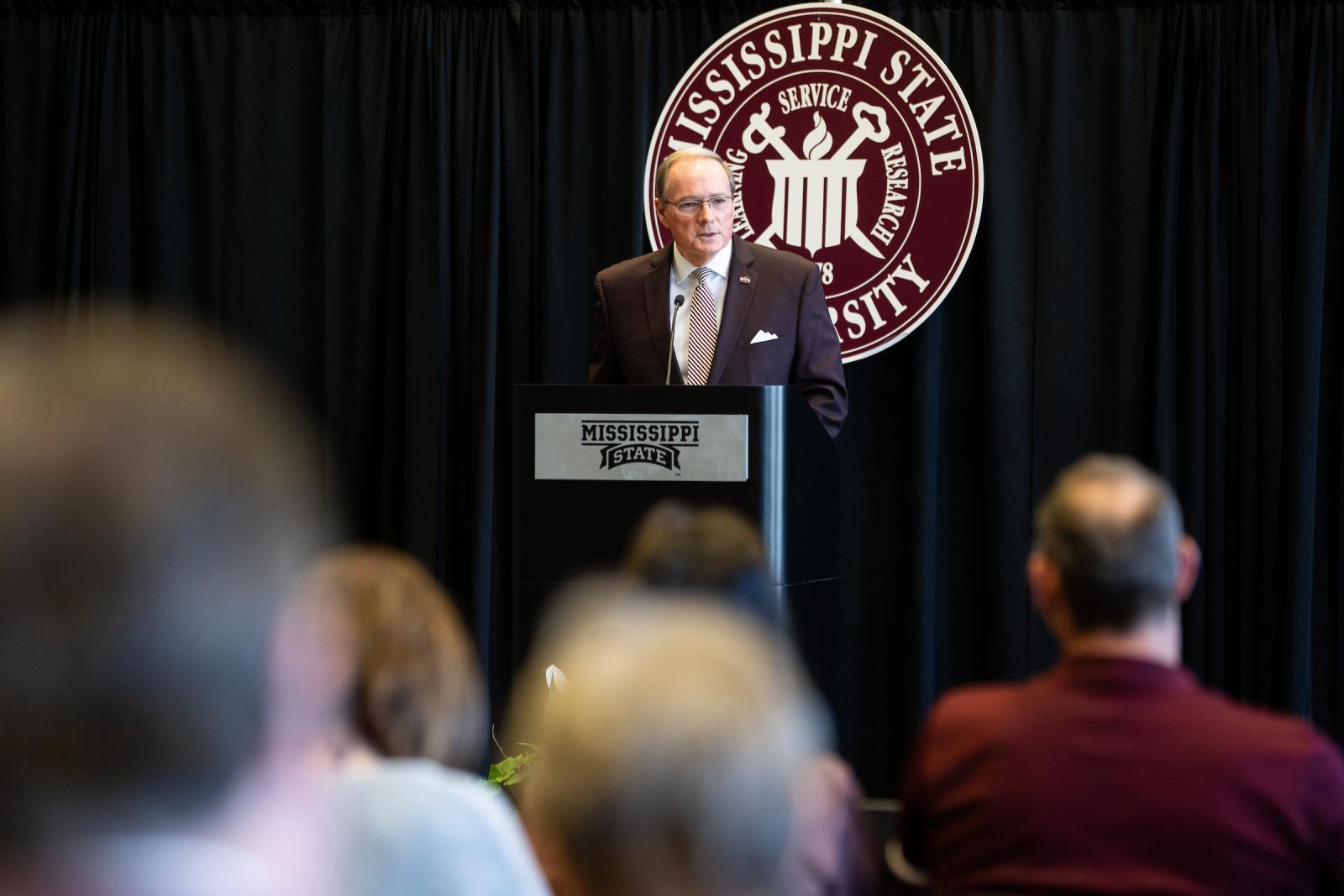
In addition to educating nearly 24,000 students, Keenum noted the university’s work in every county of the state, as well as MSU’s national and global impacts. The state’s leading research university also works closely with Mississippi industries.
For example, Keenum said manufacturers look to MSU’s engineering help to optimize efficiency and competitiveness and lead the next generation of technology, including in the areas of artificial intelligence and cybersecurity.
He said farmers, ranchers and the entire ag economy, as well as families, households and youth, are direct beneficiaries of MSU’s breadth of programming from its science labs to the MSU Extension Service, including more than 90,000 youth participating in 4-H.
Keenum emphasized how the university is the state’s best return on investment, contributing back $25 for every dollar invested in MSU.
The university’s 19th president said he has been working hard to discuss the breadth of essential work the university does, and he has participated in two budget hearings this legislative session about priority needs.
“I’ve said my number one, in fact my only priority, is our people. That’s it. That’s our priority for Mississippi State University—our people. I also took my time to remind leaders of all that we do in the state of Mississippi.”
Provost and Executive Vice President David Shaw gave remarks focused on key student and faculty issues, from curriculum and advising changes to international exchange partnerships and faculty resource developments.
![Provost and Executive Vice President David Shaw gave remarks on academic issues ranging from curriculum and advising changes to international exchange partnerships and faculty resource developments during MSU’s Friday [Feb. 6] spring general faculty meeting.](/sites/www.msstate.edu/files/styles/msstatedrupal_large/public/2026-02/General_Faculty_Meeting_20260206_GC8_8655.jpg?itok=KzHEVCa1)
“I was really proud to be able to appoint, five years ago, a task force that looks specifically at student success,” Shaw said. He explained how recommendations and pilot studies have led to new approaches, and he emphasized how the university’s shared governance structure has fostered dialogue, leading to vetted solutions and well-planned process improvements.
“I continually welcome feedback in whatever way is appropriate, whether it’s a cup of coffee together, an email, phone call—whatever you’re most comfortable with. We can only make this place better when we talk to each other, and so I welcome the opportunity to listen,” Shaw said.
Interim Vice President for Research and Development Scott Willard outlined the work that merits MSU’s R1 “Very High Research Activity” designation from the Carnegie Foundation.
“What sets MSU apart is how we do research, not only in the basic science realm, but the focus on applied research and problem solving. This allows us to offer our students more than the world-class academic education that we give them in our classrooms, but also the opportunities to work in our centers and institutes, across research labs both here on campus and across the state,” Willard said.
He described the Thad Cochran Research, Technology and Economic Development Park as “the heart of MSU economic development.”
“With one of the fastest academic supercomputers in the country and a new next-generation data center coming online in the research park, with our partnerships with NOAA and USDA, our researchers work on a grand scale with interdisciplinary research in climate, weather, artificial intelligence, autonomy, cybersecurity, agriculture, simulation and so much more,” Willard said.
Vice President of the Division of Agriculture, Forestry and Veterinary Medicine Keith Coble said nearly 45% of all MSU research falls within his division, with a 20% increase in research funding in 2024.
“Our headquarters for DAFVM are here in Starkville, but our campus is the entire state of Mississippi and beyond,” Coble said. “Our statewide footprint includes four research and extension centers; 16 farms; three CVM diagnostic clinics; we have Extension in every county, as President Keenum mentioned. With the addition of the recently acquired 14,000-acre Wolf River tract, we have 25 forests scattered around this state; we maintain over 175 buildings; farm 16,000 acres; … plant about 200,000 pine trees each year; and manage 1,800 cattle, 150 of which produce milk that turns into 50,000 balls of Edam cheese. We support the ag and forest industry, and we do that really well,” Coble said.
Mississippi State University is taking care of what matters. Learn more at www.msstate.edu.