
MSU announces new graduate programs in One Health
Contact: Wade Leonard
STARKVILLE, Miss.—Mississippi State, a longtime leader in One Health principles, now is offering two new graduate programs focusing on this public health approach that recognizes the interconnectedness of animal, human and environmental wellbeing.
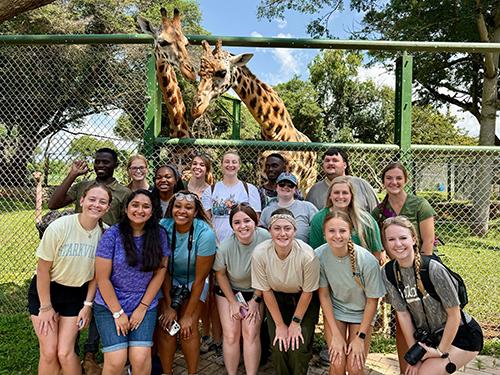
Beginning this fall, MSU’s College of Veterinary Medicine is offering One Health graduate programming, a Master of Science with two distinct tracts and a certificate for professionals looking to expand their knowledge and skillsets. The options are in collaboration with the College of Agriculture and Life Sciences and College of Forest Resources.
One Health is an interdisciplinary and scientifically holistic field promoting collaboration across medicine, veterinary science, environmental science and related disciplines to better detect, prevent and respond to health threats on a local and global scale.
“One Health is a viewpoint. It’s a lens that we are trying to help our students see through so they can be better leaders for the future,” said CVM One Health Director and Associate Professor Dr. Nicole Ashpole.
An expert in neuroscience and toxicology who joined the university to lead the program last year, Ashpole has been working with an interdisciplinary team to build the new curricula. The master’s program will prepare students to tackle issues like zoonotic disease emergence, antimicrobial resistance and accelerated loss of biodiversity. A non-thesis track is a series of engaging courses designed for completion in one year that introduces key foundational concepts in data science and epidemiology, disease management, systems thinking, policy and leadership. The thesis track also is available for students who wish to pursue larger research projects under direction of One Health research professors.
The abbreviated four-course certificate program is available through MSU’s Center for Distance Education.
“At Mississippi State University, we have veterinarians, we have forestry resource specialists, agricultural specialists, agricultural scientists, social scientists, people working in the humanities, and people leading our leadership institutions,” said Ashpole. “We are perfectly positioned to bring all these people together to have our students and trainees learn from experts across all these disciplines to make a better tomorrow.”
Ashpole explained MSU has been at the forefront of One Health since the concept was coined following a series of zoonotic disease outbreaks in the early 2000s. Longtime CVM Professor Dr. Margaret Khaitsa used the approach when building the ongoing Tropical Veterinary and One Health summer study abroad collaboration between CVM and Uganda’s Makerere University.
“We bring not only veterinary students. We also bring students from other disciplines,” Khaitsa said. “They work together with their fellow students from Uganda who themselves are from different disciplines.”
Now under the leadership of Assistant Professor of Pathobiology and Population Medicine Dr. Stephen Reichley, CVM students and professors spend a month each summer in the African country, working across disciplines to experience the philosophy and application of One Health in the field.
“Because of the program Dr. Khaitsa founded, our experience with One Health at this university is vast. The fact that you have Mississippi students learning from Ugandan students and vice-versa is the very heart of One Health because our students get to bring that knowledge about animal production and wildlife disease surveillance back with them,” Ashpole said.
In 2021, Khaitsa was named to the One Health High-Level Expert Panel, which advises the Food and Agriculture Organization of the United Nations, the World Organization for Animal Health, United Nations Environment Program, and World Health Organization.
Grounded in MSU’s land-grant mission, the Division of Agriculture, Forestry, and Veterinary Medicine has worked for generations to improve the health and resilience of people, animals and the environment across the Magnolia State and beyond. The new One Health programs build on this legacy by preparing students to apply integrated thinking and strategic problem-solving to global health challenges.
For more information about the MSU College of Veterinary Medicine’s One Health graduate programming, visit www.vetmed.msstate.edu/onehealth.
Mississippi State University is taking care of what matters. Learn more at www.msstate.edu.