
MSU scientist discovers manatees are not just cruisin’ the coast
Contact: Meg Henderson
STARKVILLE, Miss.—J.R.R. Tolkien once wrote “Not all those who wander are lost,” but West Indian manatees found moving from Florida up the Atlantic seaboard or west into the northern Gulf of Mexico are sometimes believed to be lost or just searching for seasonal forage. Now, a scientist with the Mississippi Agricultural and Forestry Experiment Station is adding to that data, demonstrating Mississippi’s coastal habitats support reproductive activity and longer-term residency for this mammal species.
Holley Muraco, an assistant research professor in Mississippi State’s Department of Animal and Dairy Sciences at the university’s Coastal Research and Extension Center, analyzed rare video footage of active mating behavior, captured in the fall of 2024 at the Grand Bay National Estuarine Research Reserve in Moss Point. The video, shot from an uncrewed aerial system, caught a group of three manatees known as a “mating herd” in action.
“Despite their chunky appearance, manatees’ fat provides limited thermoregulation abilities,” Muraco said. “Manatees have an evolutionary biology to seek out a range where survival is possible, and they have been documented traveling farther from Florida and staying longer on the Gulf Coast than in the past.”
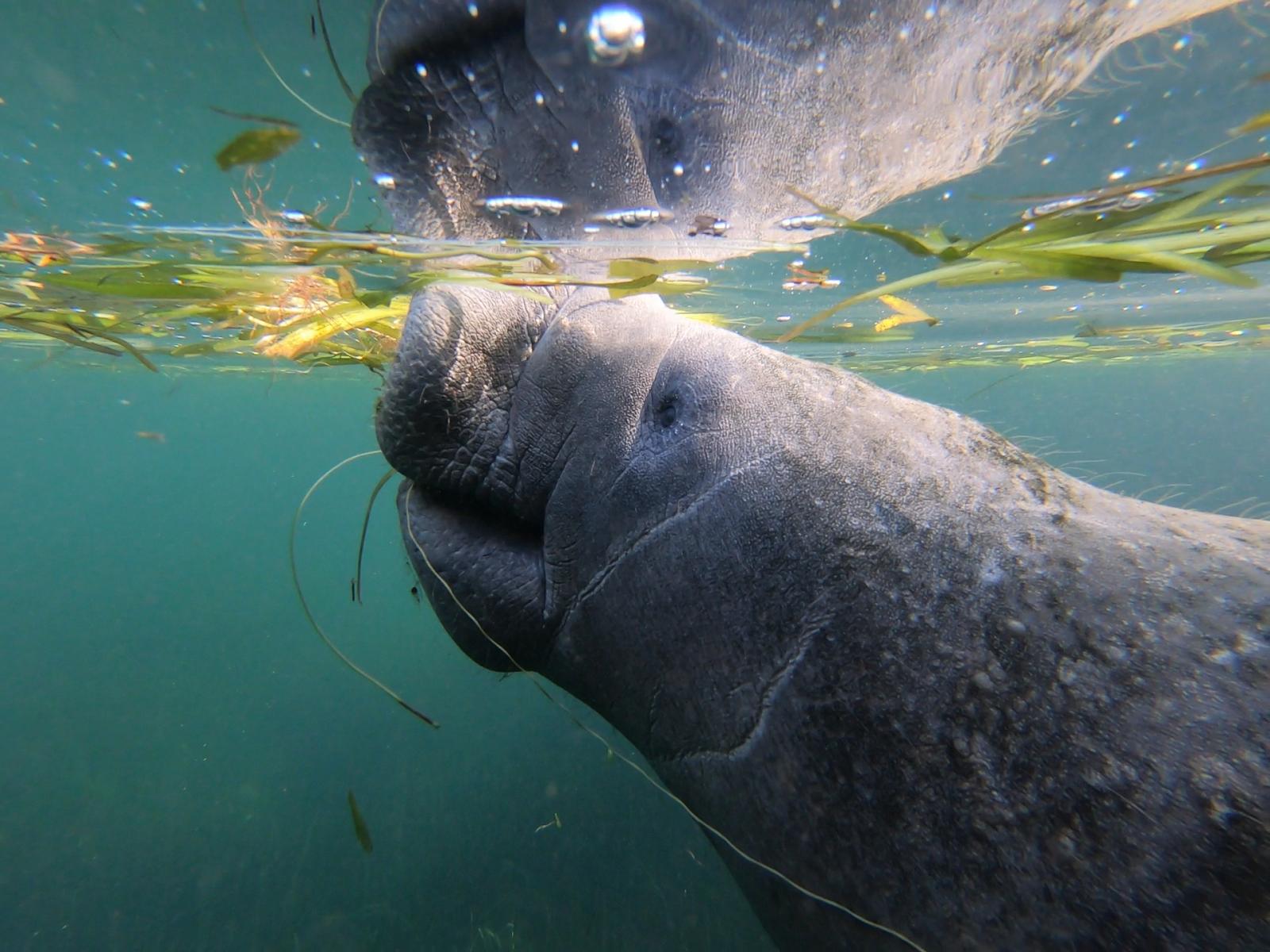
In the winter months, aggregations of manatees have historically sought out warm-water refuges in Florida’s springs and areas where power plants discharge warm water. Muraco explained that, although Florida is where they typically overwinter, these “sea cows” are tied directly to specific habitat conditions—water temperatures above 68 degrees and plentiful supplies of seagrass and other submerged aquatic vegetation—regardless of geographic location.
Although active mating herds are regularly sighted in the northern Gulf, the high-resolution drone video footage allowed Muraco to observe and meticulously analyze mating behaviors and interactions for the first time in turbid Mississippi waters. The use of this technology holds promise for studying and discovering more about these elusive creatures.
Muraco’s study references data collected by the Dauphin Island Sea Lab’s Manatee Sighting Network. Since 2007, the network has documented over 8,000 sightings, tagging and tracking manatees in the northern Gulf from the Florida panhandle to the U.S./Mexico border.
DISL Senior Marine Scientist Ruth H. Carmichael noted the sighting network has documented increasing numbers of manatees in the region during the last 20 years.
“The combination of population recovery and long-term environmental change is likely driving greater manatee numbers outside of Florida,” Carmichael said.
Muraco soon will launch a project in collaboration with the Grand Bay NERR to identify thermal refuges within the reserve. She also hopes to investigate waters near power plants along the Mississippi coast as potential manatee habitats.
Understanding the behavior of these “gentle giants” is critical for environmental and wildlife conservation and for boater safety. The greatest cause of manatee mortality occurs when the aquatic mammal surfaces to breathe and collides with a fast-moving boat. This risk is heightened by low visibility in the turbid waters along the Mississippi coast.
“We know from this study that these manatees are not just idly passing through Mississippi’s coastal waters. We know our habitats are supporting their health sufficiently to reproduce. Sighting this active mating herd is evidence that there are more manatees in the area, and our observations highlight the need for greater monitoring and conservation efforts here,” Muraco said.
The public may report sightings or manatees in distress to the DISL’s Manatee Sighting Network anytime by phone at 1-866-493-5803, online at manatee.disl.edu, or email to manatee@disl.org. Manatee habitat area signage is provided free of charge to waterfront residents, municipalities and agencies throughout Mississippi and Alabama.
Mississippi State’s Mississippi Agricultural and Forestry Experiment Station conducts research to enhance coastal environments and habitats through a One Health approach, recognizing the interconnected health of people, animals, plants and their shared environment. As a sentinel species, manatees serve as indicators of environmental quality, with their health reflecting the overall condition of coastal ecosystems. Learn more about MAFES at www.mafes.msstate.edu.
Mississippi State University is taking care of what matters. Learn more at www.msstate.edu.