
Eye in the Sky: MSU grad student surveys waterfowl with drone technology
Contact: Meg Henderson
STARKVILLE, Miss.—Miles from Biloxi’s casino row, there’s a place attracting a different kind of tourist: birds migrating down the Mississippi Flyway, placing their bets on the Coast’s mild winter climate.
Mississippi State wildlife, fisheries and aquaculture master’s student Nate McGregor of Ocean Springs is using the Grand Bay National Estuarine Research Reserve, or NERR, as an outdoor laboratory. Working with Assistant Extension Professor Jonathan Pitchford in the College of Forest Resources, McGregor is conducting uncrewed aerial surveys of migratory waterfowl to establish a baseline population overview of understudied birds, such as redhead ducks and lesser scaup, that overwinter on the Mississippi Coast.
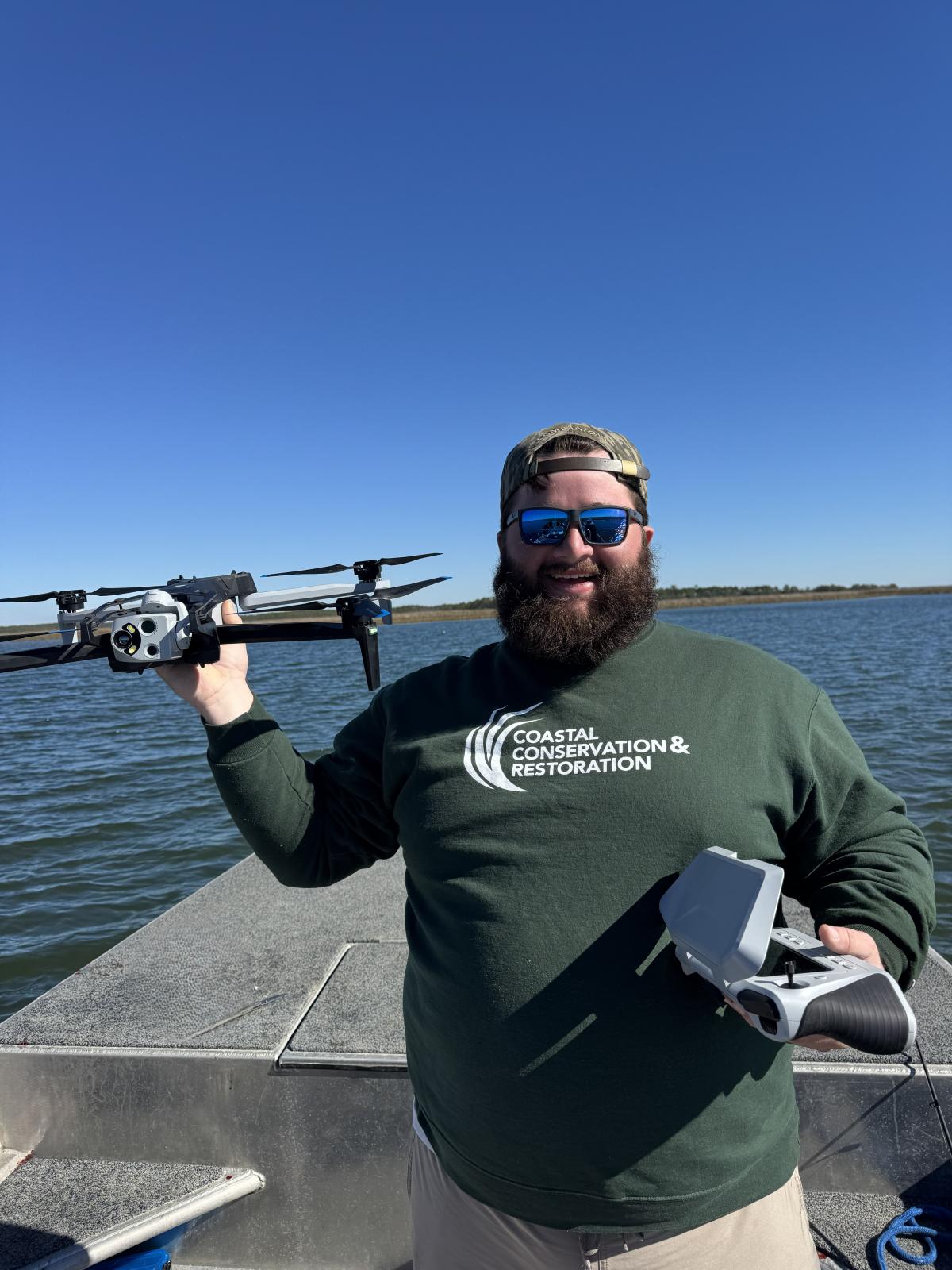
“Each winter, the U.S. Fish and Wildlife Service conducts aerial surveys of the Mississippi Flyway by airplane, and waterfowl populations on the Mississippi Coast are usually very low, especially if cold fronts have not yet pushed migratory birds southward,” McGregor said. “I wanted to conduct more regular surveys to investigate our transient populations that are often difficult to monitor.”
“We want to comprehensively understand the reserve’s natural resources, and waterfowl has historically been a data gap for us,” said Pitchford, a wildlife fisheries and aquaculture faculty member and McGregor’s advisor. “Nate’s project is filling a critical need that can help with conservation efforts.”
A Kentucky native whose biologist father instilled knowledge and reverence of nature from an early age, McGregor explained traditional on-the-ground surveys are time-consuming. They require driving a boat to multiple locations throughout the reserve and conducting manual counts—a task with results depending, in part, on being in the right place at the right time.
To better understand waterfowl presence across the 18,000-acre reserve, McGregor needed a different point of view. He deployed an autonomous aerial system, a drone equipped with a camera, to capture aerial footage of the NERR. He then began running collected images through AI deep-learning software trained to count and identify the birds.
“Some of the large-scale images have up to 3,000 individual ducks, which look like grains of rice on a computer screen, but the software makes quick work of counting,” he said. “And some of the images captured from closer up have challenged my assumptions about where we would find ducks and how they group together.”
McGregor, who also works as a full-time MSU Extension associate at the Coastal Research and Extension Center, said the study is just beginning the work he hopes to pursue on behalf of the NERR-based partnership between MSU and the Mississippi Department of Marine Resources. Although waterfowl is his greatest passion, McGregor’s job at the NERR includes a wider scope of stewardship and land management, including hosting educational, hands-on, wild pig-trapping workshops.
“On its own, my master’s project has implications for waterfowl hunting regulations, which are set at the federal and state levels based on breeding population estimates,” he said, “but I also want to use this research as a foundation for future projects with land-management applications, like movement-based tracking or fine-scale studies of individual species.”
To learn more about MSU’s Department of Wildlife, Fisheries and Aquaculture, visit www.wildlifefisheries.msstate.edu. Find the College of Forest Resources at www.cfr.msstate.edu.
Mississippi State University is taking care of what matters. Learn more at www.msstate.edu.