
MSU scientists help verify origin of cotton’s domestication
Contact: Vanessa Beeson
STARKVILLE, Miss.—Cotton is the world’s leading source of natural textile fiber, but much of its genetic history remains a mystery. Mississippi State scientists are part of an international team investigating when and where cotton was first domesticated. Their findings, recently published in the Proceedings of the National Academy of Sciences, weave together a clearer picture of cotton’s genomic past while offering insight to help improve the crop’s future.

Researchers sequenced nearly 400 wild and domestic cotton plants across Florida, the Caribbean and Mexico. They traced modern cotton’s roots to Mexico’s Yucatán Peninsula more than five millennia ago, uncovering genetic diversity that could help today’s breeders develop more resilient cotton.
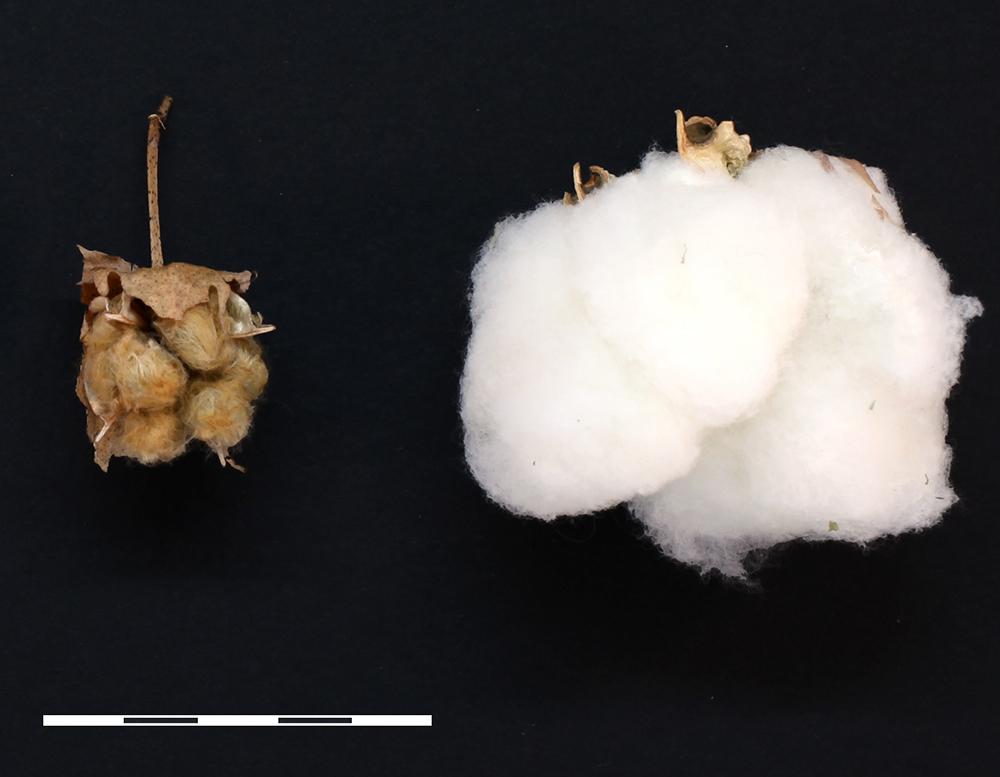
Professor Dan Peterson, head of MSU’s Department of Biochemistry, Nutrition and Health Promotion and a Mississippi Agricultural and Forestry Experiment Station scientist, said the team confirmed a longstanding hypothesis that the Northwestern Yucatán Peninsula was the center of domestication of Gossypium hirsutum, known as upland cotton. Peterson noted wild specimens of the species hold valuable reservoirs of traits that could improve the crop today.
“When breeders select plants for desirable traits, they create highly specialized cotton varieties but also reduce genetic diversity,” he said. “As diversity declines, so does the plant’s ability to withstand new threats. Protective genes can be lost during breeding, leaving modern cotton vulnerable to emerging diseases. That’s why wild cotton populations are vital. Their rich genetic diversity continues to evolve under natural environmental pressures, providing valuable traits for future breeding efforts.”
Peterson said researchers have studied the origin of cotton’s domestication for more than 75 years. Early scientists noticed much of cotton’s diversity appeared to originate in the Yucatán, supported by closely related plant types and archaeological evidence of ancient people in the area using cotton.
“We’re confirming and building upon what earlier researchers discovered through years of painstaking work,” Peterson said.
Sequencing a genome, he said, is like solving a jigsaw puzzle.
“We can’t read a chromosome from end to end. We must sequence then reassemble many DNA pieces. In the past, those pieces were very short, making the process incredibly complex. Recent advances allow us to sequence much longer DNA stretches,” Peterson said. “It’s the difference between solving a 100-piece puzzle compared to one with a million pieces.”

Tony Arick, interim director of the MSU Institute for Genomics, Biocomputing and Biotechnology, said the modern process is easier and less expensive.
“The longer the DNA string, the better and easier it is to map. Using the jigsaw puzzle analogy, it’s much easier to see the big picture when there are fewer missing pieces,” he said.
Iowa State University’s Corrinne Grover and Jonathan Wendel served as co-principal investigators on the research. In addition to Peterson and Arick, MSU IGBB collaborators include Chuan-Yu Hsu, Zenaida V. Magbanua and Olga Pechanova. The Universidad Nacional Autónoma de México, Universidad Autónoma de Yucatán, University of Neuchâtel, U.S. Department of Agriculture’s Agricultural Research Service and the Chinese Academy of Agricultural Sciences also contributed to the work.
Visit MSU’s Institute for Genomics, Biocomputing and Biotechnology at www.igbb.msstate.edu. Learn more about the Mississippi Agricultural and Forestry Experiment Station at www.mafes.msstate.edu.
Mississippi State University is taking care of what matters. Learn more at www.msstate.edu.