
Disc golf hall of famer visits MSU Athlete Engineering for advanced insights on biomechanics, performance
Contact: James Carskadon
STARKVILLE, Miss.—A world-renowned disc golf champion and influential teacher recently visited Mississippi State’s Athlete Engineering Institute to better understand how the mechanics of throwing impact performance and injury prevention in one of the world’s fastest-growing sports.
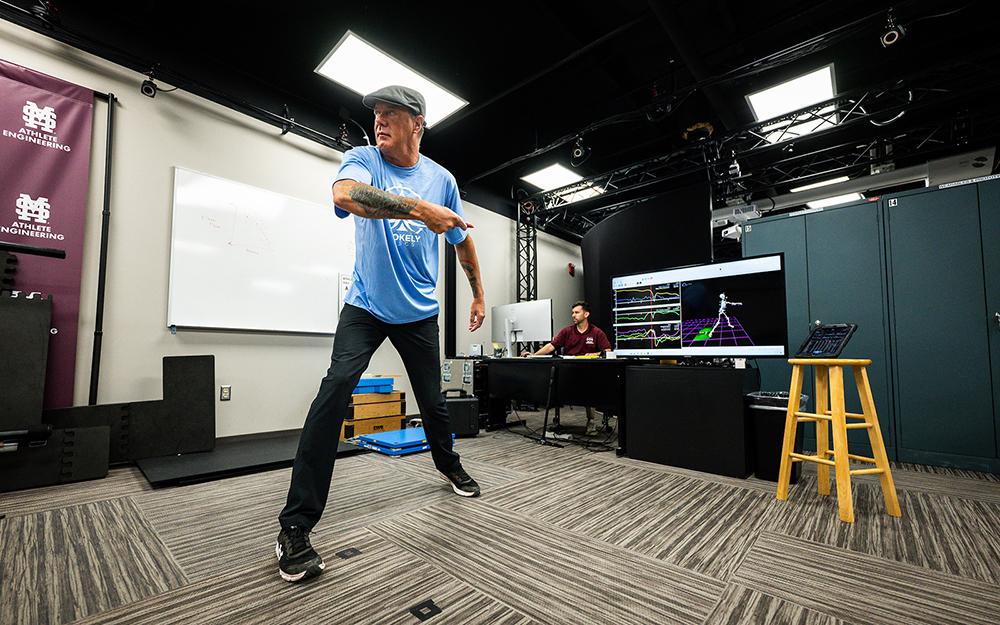
Scott Stokely, a 17-time world and national disc golf champion and Disc Golf Hall of Fame member, spent multiple days in Starkville working with AEI Research Engineer David Saucier, using the lab’s advanced markerless motion capture technology to study biomechanics of the disc golf throw.
Stokely, who now travels internationally teaching disc golf technique, said the opportunity to pair decades of experience with objective data was a natural next step for the sport.
“As disc golf grows and becomes more mainstream, we also get access to more mainstream research tools,” Stokely said. “Coming to Mississippi State was about finding out what’s actually true—confirming or challenging what we think we know—so we can teach better, throw better and reduce injuries.”
At AEI, researchers used high-speed, markerless motion capture to analyze Stokely’s throwing mechanics in detail. The system uses advanced computer vision and machine-learning algorithms to track full-body motion in real time.
“Markerless motion capture lowers the barrier significantly,” Saucier said. “We can collect high-quality data faster, take the system out of the lab and apply it to real-world sports movements. There’s still a lot of trial and error as we use this system in different ways, but we’re definitely at the forefront of this technology.”
The university’s AEI has completed studies across multiple sports, including softball, basketball, football and baseball, often in conjunction with MSU Athletics. Saucier noted these projects combined advanced technology and expertise to address needs identified by athletes and coaches.
A key focus of the collaboration is testing Stokely’s long-held belief that optimal performance mechanics are the same mechanics that reduce injury risk, a principle he has observed across decades of competition and instruction.
“In disc golf, it appears that throwing farther, throwing more accurately and reducing injuries all come from the same correct mechanics,” Stokely said. “If that’s true, and the data helps us test that, it means players don’t have to choose between performance and longevity. Not every sport can say that. In some sports, there’s a trade-off. Our sport doesn’t appear to be that way. If that’s the case, it just further supports my belief that our sport has so much to offer.”
Saucier said the visit also helped establish future research questions and collaborative opportunities, including the possibility of studying a larger pool of players to better understand how individual differences affect throwing mechanics.
For more on MSU’s Athlete Engineering Institute, visit www.aei.msstate.edu.
Mississippi State University is taking care of what matters. Learn more at www.msstate.edu.