
MSU leads multi-institutional study of novel system to improve water quality
Contact: Meg Henderson
STARKVILLE, Miss.—A cross-departmental team of Mississippi State scientists is exploring new ways to improve water quality, from the Mississippi River to the Gulf of Mexico.
Their solution begins at the edge of agricultural fields, where excess fertilizer enters the waterway, fueling algal blooms that block sunlight and create low-oxygen “dead zones” as they decompose.
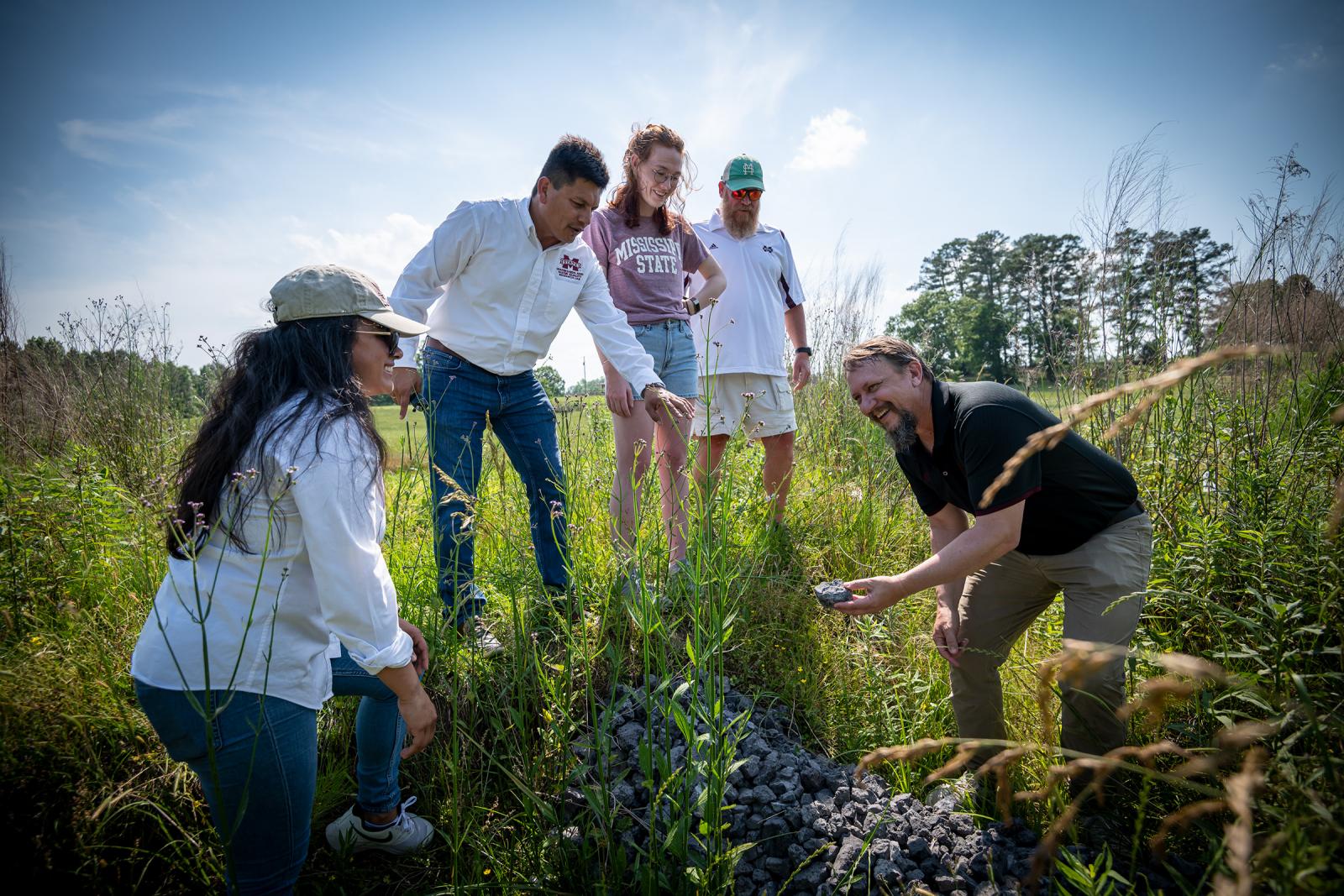
Principal investigator Tim Schauwecker, an MSU landscape architecture and environmental design professor and Mississippi Agricultural and Forestry Experiment Station scientist, is leading a three-year, $1.4 million EPA-funded study to test and demonstrate the effectiveness of his team’s novel slag bioreactor-based edge-of-field conservation system. This physical barrier halts the fertilizer nutrients’ journey before it can begin.
“Both nitrogen and phosphorus feed algal blooms, but nitrogen comes from different sources, even the atmosphere, and is harder to control,” he said. “We are targeting phosphorus because capturing it is key to controlling the algal blooms.”
In addition to MAFES, the university team includes MSU Extension, the university’s Rula School of Civil and Environmental Engineering Watersheds and Water Quality Research Lab, and the National Center for Alluvial and Aquifer Research in Stoneville, which is a partnership between MSU and the USDA. The team also is partnering with USDA’s National Sedimentation Lab in Oxford. Slag barriers will be provided by the Edw. C. Levy Company, a global steel producer with a mill in Columbus.
John Ramirez-Avila, a civil and environmental engineering associate professor, plays a pivotal role in designing the system, using new technology that has proven effective in recent studies.
“Slag is a co-product of steel production, often used for gravel roads or base material construction,” Ramirez-Avila said. “It acts on phosphorus through a process called adsorption, where chemical reactions make the dissolved phosphorus stick to the slag. Unlike vegetative buffers, which primarily trap sediment and sediment-bound nutrients, a slag bioreactor removes dissolved phosphorus year-round. Because dissolved phosphorus is immediately available for algae to use, removing it can help reduce algal blooms.”
Following laboratory tests coordinated by Sandra Ortega Achury, an MSU research associate, the team is establishing a trial site at the Delta Research and Extension Center in Stoneville to establish best management practices. After a year of monitoring the site, slag bioreactors will be installed at four demonstration sites across the state to showcase the research to farmers and other stakeholders.
Community engagement and communication are key to the program’s success, according to Drew Gholson, an associate Extension professor in plant and soil sciences and MAFES scientist, and Beth Baker, an associate Extension professor in wildlife, fisheries and aquaculture and assistant director of Extension for environmental stewardship. As outreach leaders, the two are currently planning on-site workshops at the four demonstration sites, regional stakeholder meetings and informational videos.
Ramirez-Avila explained the project’s research, outreach and education components contribute to the goals of the EPA Mississippi River/Gulf of America Hypoxia Task Force and the Gulf of America Alliance, a partnership led by governors of the five Gulf states to protect and strengthen the resilience of shared coastal habitats and wildlife.
“While this is one of many efforts in these partnerships’ broad strategy, it is a promising solution that, combined with the many different regional, statewide and national strategies and projects, will have a positive impact on protecting ecosystems downstream,” he said.
Schauwecker added, “That is why educating farmers about the unseen impacts of agricultural nutrients and providing solutions to contain them is so important. When farmers choose to be a part of programs like ours, they contribute to those greater efforts.”
This project is funded by the Farmer-to-Farmer program, overseen by the EPA.
To learn more about the Mississippi Agricultural and Forestry Experiment Station, visit www.mafes.msstate.edu.
Mississippi State University is taking care of what matters. Learn more at www.msstate.edu.