
MSU EcoCAR team gives university leaders first look at Blazer EV for upcoming national competition
Contact: Chris Whitaker
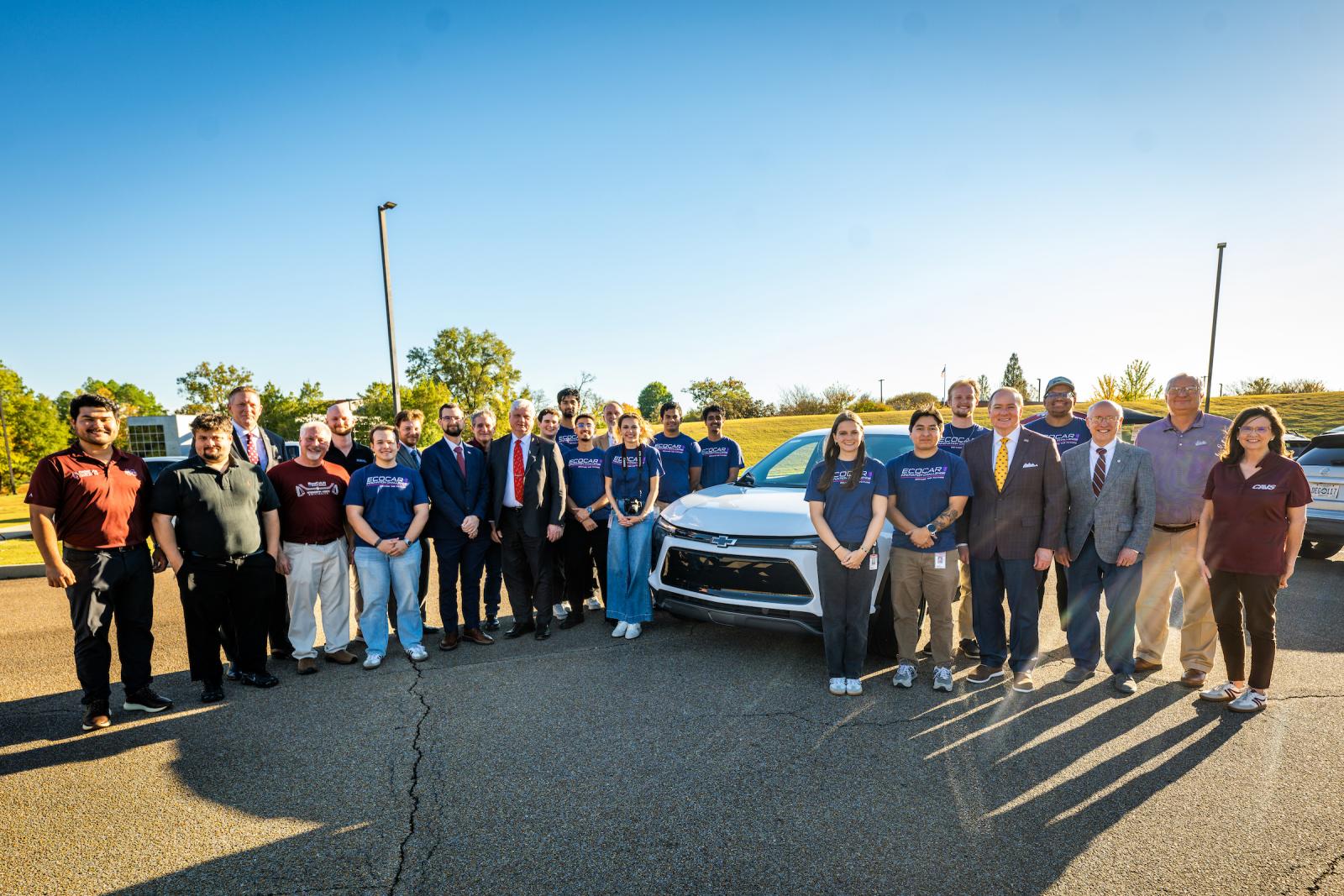
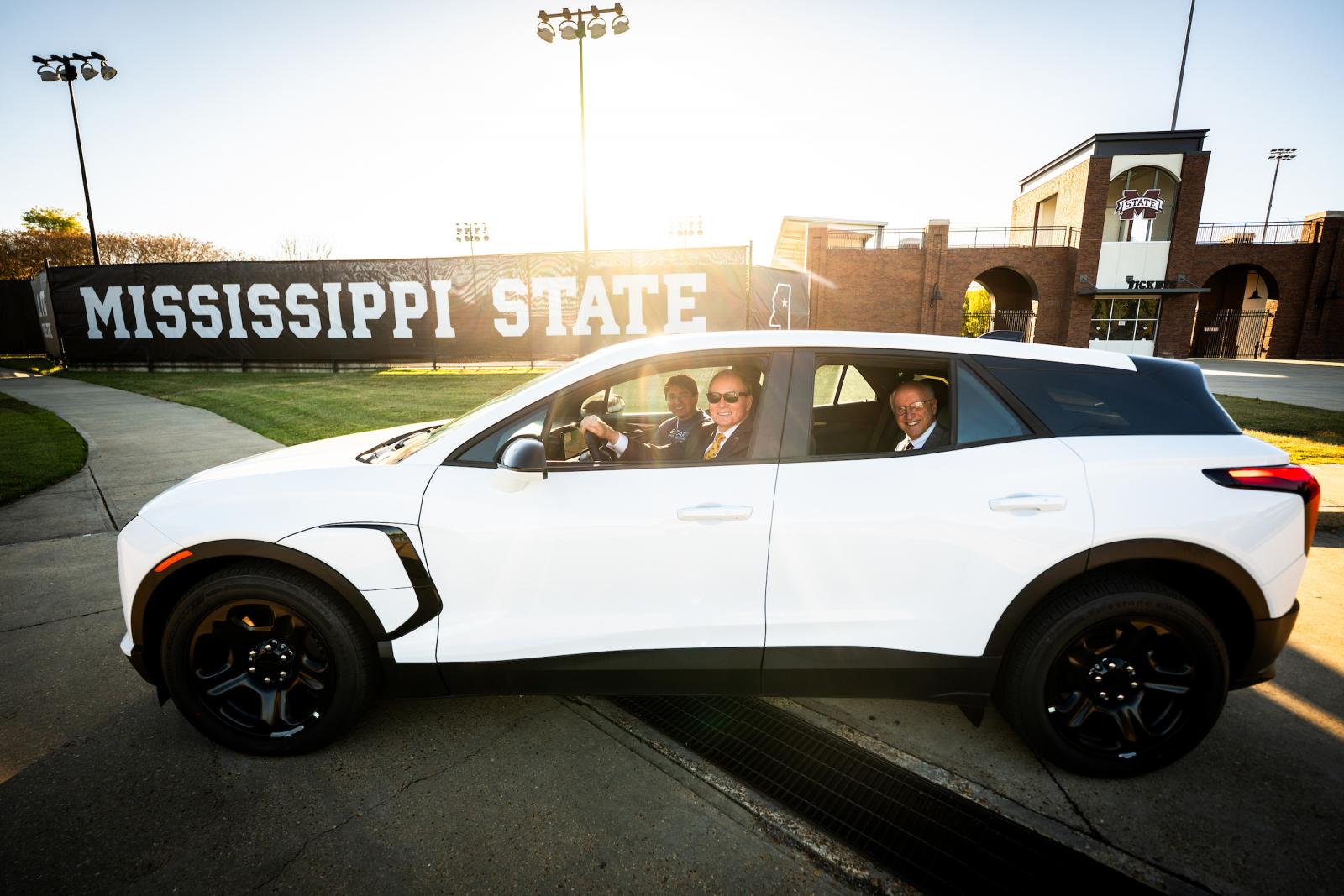
STARKVILLE, Miss.—Mississippi State leaders got a first look at the future of automotive innovation today [Nov. 6], taking turns driving the stock Chevrolet Blazer EV that students will spend four years reimagining for the national EcoCAR Innovation Challenge.
The Innovation Challenge, launched this fall, is part of the U.S. Department of Energy’s Advanced Vehicle Technology Competitions, running for nearly four decades. MSU has participated in EcoCAR competitions since 2004, winning multiple awards, including four first-place team titles. The university team and individual student members won 14 titles and honors for outstanding community impact, faculty advising and workmanship during the last EV Challenge competition.
MSU was selected as one of 20 North American universities picked for the current round of competition, which for the first time will feature two tracks named after sponsoring automakers General Motors and Stellantis, with the Bulldogs competing in the GM track. A champion is crowned each year, so the MSU team has sights set on Year 1’s final workshop next May in San Antonio.
MSU President Mark E. Keenum and Provost and Executive Vice President David Shaw were first to spin the wheels of the police pursuit vehicle that currently features two motors, around 615 horsepower and a 0-60 mph time of 3.4 seconds.
“Mississippi State has a proud tradition of success in EcoCAR, and that success reflects the talent and hard work of our students and the world-class faculty and staff who guide and support them,” Keenum said. “This competition gives our students an outstanding opportunity to put what they learn in the classroom to work solving complex, real-world challenges. Experiences like this prepare them with the knowledge, skills and confidence to become leaders in a rapidly changing world.”
The MSU team’s first-year focus is on architecture selection, propulsion controller design, baseline propulsion testing and autonomous system design. Students are redesigning the Blazer’s powertrain, including its motors and the software that controls them. They also are working to implement SAE Level 4 autonomy, meaning the vehicle can drive itself in limited conditions. Planned features include cooperative adaptive cruise control, lane centering, automatic intersection navigation and automatic path following.
“EcoCAR provides an extraordinary learning environment where students can bring together engineering, computing, business and entrepreneurship to tackle challenges that mirror those they will face in their careers,” Shaw said. “They are gaining deep technical knowledge, but they are also learning how to collaborate across disciplines, think creatively and turn innovative ideas into practical solutions. That kind of experience is invaluable preparation for the workforce of tomorrow.”
New for the 2026-2030 competition, the Product Innovation Track trains students in entrepreneurship, guiding teams through customer interviews, business planning and pitches to investors and industry professionals. Over the four-year competition, each team will narrow its early project ideas to a single product.
Working out of MSU’s Center for Advanced Vehicular Systems, the MSU team is made up of seven subteams and more than 60 students with eight advisors. Four engineering subteams focus on propulsion controls, vehicle hardware, self-driving technology and vehicle systems, while three business subteams focus on marketing and communication, product innovation and project management.
“Year 1 of the EcoCAR Innovation Challenge is an opportunity for our team to establish a strong foundation, develop innovative solutions and build the technical and professional skills needed for success throughout the four-year competition,” said Isaac Alanis, an MSU electrical and computer engineering master’s student from Ocean Springs serving as project management and primary team lead. “It provides students with a unique opportunity to apply classroom knowledge to real-world automotive challenges, combining engineering innovation, teamwork and professional development to shape the future of the automotive industry.”
Mississippi State University is taking care of what matters.