
Across the Pond and into the Field: Visiting scholar joins MSU Ag Autonomy Institute to ‘rethink the possible’
Contact: Mary Kathryn Kight
STARKVILLE, Miss.—Kit Franklin will be the first to point out the irony. He is driven by human connection, but he’s built his career on replacing human hands with machines.
“Automation is just the means to the end. The end is always about helping farmers,” he said.
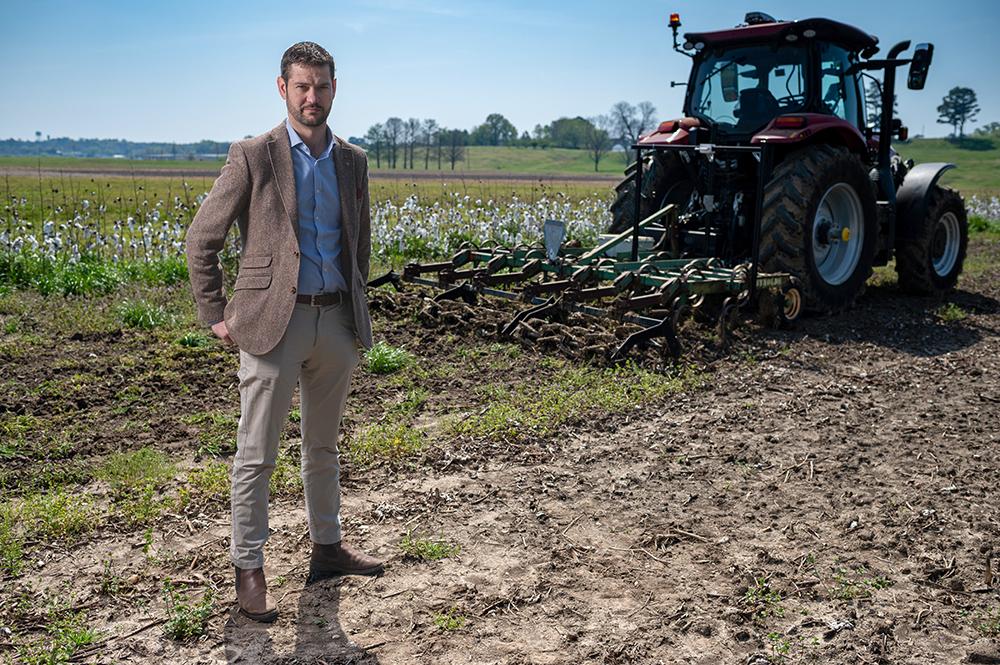
Franklin is a visiting agricultural engineer at Mississippi State University’s Agricultural Autonomy Institute and one of the most recognized figures in the development of autonomous farming worldwide. As the lead at Harper Adams University in England on the Hands-Free Hectare project, the world’s first fully autonomous cropping cycle, Franklin earned interviews with media, spoke before British politicians and royalty, and helped put agricultural autonomy on the global map.
When MSU AAI Director Alex Thomasson traveled to the U.K. in 2021, he made a point of meeting Franklin in person.
“I really wanted to have an international scholar come and spend time with us, and he was the key person I wanted,” Thomasson said.
Franklin attended the institute’s grand opening at MSU in fall 2023 and was involved in some of AAI’s early work at the university. When he returned for a six-month residency in fall 2025, he found something far more substantial than the institute he had seen take its first steps.
During the two years between Franklin’s visits, the AAI grew to an institute that now operates the largest fleet of U.S.-manufactured spray drones of any academic institution, formed a research partnership with John Deere and secured funding from the Sugar Cane Growers Cooperative of Florida to develop a novel AI-based system.
AAI Associate Director Madison Dixon, who has watched the institute grow from its earliest days, said he’s proud of the progress.
“We started from square one with a vision from Dr. Thomasson and some seed funding,” Dixon said. “Three years later, we’ve done exactly what we intended to do, and we’ve only begun to scratch the surface.”
Franklin has been directly involved in the sugar cane project, helping incorporate a new sensor that reshaped the prototype’s direction. He also worked with MSU Research Associate Luke Gray to establish safety and organizational policies.
“Safety has been the hallmark of the effort,” Dixon said. “Kit has helped us make the most of the space we have and put policies in place to support our work.”
For Hussein Gharakhani, an assistant professor of agricultural and biological engineering, Franklin has been a valuable collaborator on multiple projects.
“He is one of those people that I can talk with easily, and we can transfer ideas in a second,” said Gharakhani, who has worked with Franklin on autonomous machinery safety research and a new course in advanced precision agriculture technology, benefiting from Franklin’s perspectives on European testing protocols and safety procedures.
Franklin and Thomasson traveled together to California and Washington to meet specialty crop growers in January, and what they saw underscored why the creation of autonomous machinery is so urgent. In Washington, orchard after orchard went unharvested the previous year because the cost of labor exceeded the revenue the crop could generate.
“There are fewer and fewer people who want to do manual labor,” Thomasson said. “Autonomous systems are being driven by labor difficulties, and that’s not going away.”
High-value specialty crops require nuanced, variable work that current systems aren’t yet equipped to handle on a large scale. Closing that gap and making the technology practical enough to work in real farm conditions is the challenge.
“We want to be an economic growth agent for the state of Mississippi. We want to build some of that business here. Ultimately, our goal is to solve a significant chunk of the world’s problems around automation relative to food production, because the world needs us to do this,” Thomasson said.
Franklin has thrown himself into more than research while at MSU. He ate crawfish on the banks of the Mississippi River in Natchez. He cheered on the Bulldogs at football, basketball and baseball games. He drove through the Delta and met people along the way.
“It’s rewarding to feel appreciated by someone who’s come all the way across the pond,” said Dixon, who grew up in the Delta. “He shows a genuine interest in wanting to learn more about Mississippi and how he can help the institute, the university and the state.”
That, in the end, is what Franklin said drew him here—not prestige, but purpose. Franklin has spent his career trying to solve challenges for farmers, and he found people at MSU who share the same passion.
“Ask anyone in agriculture what farming will look like in 20 years, and they’ll likely say, ‘shinier tractors, higher costs, less profit,’” Franklin said. “What we need to say instead is: rethink the possible. That’s what they’re doing at the Agricultural Autonomy Institute, and I’m proud to play a small part in that.”
Mississippi State University is taking care of what matters. Learn more at www.msstate.edu.