
International Institute at MSU announces 2026 Global Development Seed Grant cohort
Contact: Chance Carden
STARKVILLE, Miss.—Under the umbrella of the university’s International Institute, Mississippi State is launching a new round of globally focused research through the International Research Development Office and its Global Development Seed Grant program.
The 2026 GDSG cohort includes six awardees initiating projects spanning climate resilience, community health, sustainable agriculture, mineral innovation and social development across the world. The program continues MSU’s commitment to building impactful international partnerships and positioning faculty for competitive external funding.
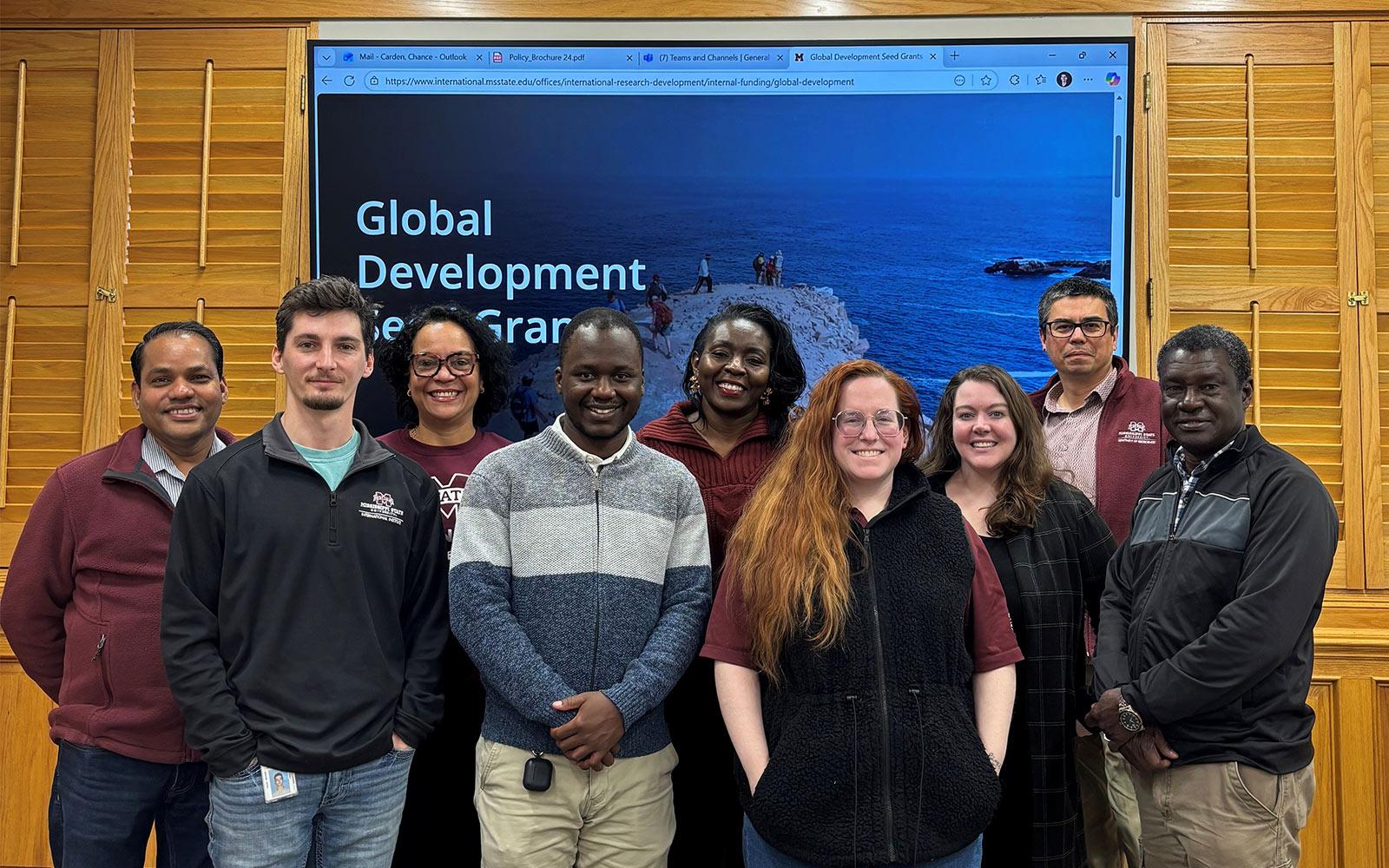
“We are excited to support faculty as they launch work that strengthens MSU’s international engagement and creates new opportunities for collaboration,” said International Institute Deputy Director Masey Smith. “This cohort demonstrates how MSU researchers are advancing practical, globally relevant solutions in collaboration with partners around the world.”
The 2026 awardees are:
—George Awuni, Extension Specialist I, Department of Plant and Soil Sciences. “Survey of Smallholder Farmers on Challenges and Opportunities of Soybean Production and Weed Management Practices in Ethiopia” with MSU co-principal investigator Amadeo Panyi, Department of Agricultural Economics. Awuni’s project will gather much‑needed economic and safety data comparing manual weeding and herbicide use among Ethiopian soybean farmers. Findings will inform future extension programs, policy decisions and sustainable weed management strategies.
—Padmanava Dash, Professor, Department of Geosciences. “Integrated Satellite Observations and System Dynamics Modeling to Advance the Resilience of Chilika Lake” with MSU co-principal investigator Prakash Jha, Department of Plant and Soil Sciences. Dash’s team will expand MSU’s long‑term water quality and ecosystem resilience research in India’s Chilika Lake by integrating satellite data, vegetation modeling and system dynamics frameworks. Working with partners in the UK and India, the project will enhance predictive tools used for climate adaptation and lagoon management.
—Rinat Gabitov, Associate Professor, Department of Geosciences. “Rare Earth Uptake by Apatite: Implications for Critical Mineral Formation” with MSU co-principal investigator Vaughn Reed, Department of Plant and Soil Sciences. Gabitov’s interdisciplinary project will explore how apatite incorporates rare earth elements under hydrothermal conditions. Findings will strengthen international collaboration with Austria’s TU Graz University of Technology and will contribute to global understanding of critical mineral formation needed for clean‑energy technologies.
—Caroline Kobia, Associate Professor, School of Human Sciences. “A Three‑Phase Initiative for Sustainable Menstrual Hygiene, Education Access, Community Development, and Economic Innovation in Kenya” with MSU co-principal investigator Kristen Cockrell‑Barnett, Department of Communication, Media and Theatre. Kobia’s team will implement Phase 2 of a multi‑phase initiative in Kenyan communities, delivering reusable pad production training, menstrual hygiene education and baseline data collection.
—Leyla Rios de Alvarez, Assistant Professor, Department of Animal and Dairy Sciences. “Natural Control of Coccidiosis in Small Ruminants.” Rios will develop an international research partnership to strengthen natural approaches for controlling coccidiosis in goats and sheep. The seed grant will support laboratory training in Canada and collaborative groundwork that will prepare for a larger in vivo study with industry partners.
—Anna Grace Tribble, Extension Specialist I, Department of Biochemistry, Nutrition and Health Promotion. “Building a Community Mental Health Assessment and Screening Framework in Dhading District, Nepal.” Tribble and partners at WE‑Nepal and Stanford University will pilot digital and in‑person modes of depression screening while training local health volunteers and community facilitators. This work will lay the foundation for a scalable rural mental‑health assessment model.
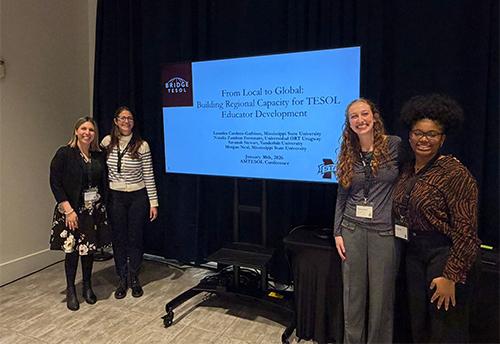
As the sole awardee in the 2025 GDSG cohort, Assistant Professor Lourdes Cardozo Gaibisso, who specializes in Teaching English to Speakers of Other Languages within MSU’s Department of English, led a major TESOL teacher development initiative. She used the competitive internal grant to launch a cross-national professional development model designed to strengthen English language instruction in both Mississippi and Uruguay. In partnership with Universidad ORT Uruguay, the project blended in-person workshops, virtual communities and transnational collaboration to create a scalable, theoretically grounded approach to ESOL teacher professional learning.
“ESOL teachers are often doing the best they can within very complex systems,” Cardozo Gaibisso said. “We wanted to build a professional space where they felt connected, supported, and grounded in strong pedagogical principles, regardless of whether they were teaching in Uruguay or in Mississippi.”
To learn more about the Global Development Seed Grant program, contact MSU International Institute Project Manager Chance Carden at ccarden@international.msstate.edu and visit https://www.international.msstate.edu/offices/international-research-development/internal-funding/global-development.
Mississippi State University is taking care of what matters. Learn more at www.msstate.edu.