
MSU awarded $850K from DARPA to advance global ag security, early threat detection
Contact: James Carskadon
STARKVILLE, Miss.—An interdisciplinary team of Mississippi State University researchers has been awarded $850,000 from the Defense Advanced Research Projects Agency, or DARPA, to enhance early detection of threats to agricultural security on a global scale.
The award funding will help establish AgSENT, or the Agricultural Security Early Notification and Threat Network. AgSENT is a prototype interface that integrates key atmospheric, environmental, supply chain, biological and societal data to highlight early warnings of potential agricultural security issues.
The funding was awarded by DARPA’s Biological Technology Office as part of its efforts to defend against naturally occurring and manmade threats to the global food systems that the world relies on. The MSU team is led by Associate Vice President for Research and Economic Development Narcisa Pricope and includes Political Science and Public Administration Associate Professor Benjamin Tkach and Computer Science and Engineering Assistant Professor Dimitrios Manias.
In addition to MSU, academic partners on the project include Virginia Tech, the University of Tennessee-Knoxville and the University of Illinois at Urbana-Champaign. The U.S. Department of Energy’s Brookhaven National Laboratory also is a collaborator.
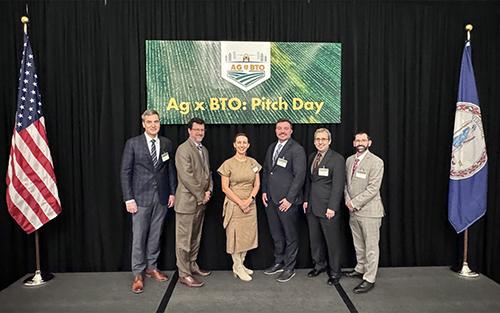
“Agriculture is a critical component of national security, and the threats to global food supplies are increasingly complex and interconnected,” Pricope said. “The goal of AgSENT is to scan a wide range of potential threat indicators and translate that data into actionable insights that can help decision-makers anticipate and mitigate risks to food security.”
Pricope noted that the DARPA award builds on university efforts to better understand the connections between agriculture and national security, such as the Food and Ag As National Security conference held in the spring of 2025.
Tkach said collaboration is needed to address the numerous challenges facing global food and agricultural issues.
“Securing the nation’s food and agricultural system requires addressing both known risks, such as climate stress, population growth and biological threats, and anticipating emergent challenges,” Tkach said. “Through AgSENT, DARPA and MSU are advancing capabilities to detect, model and respond to novel threats in a rapidly evolving global competitive environment.”
The project will benefit from the capabilities of MSU’s Applied Research Collaboratory, including the Institute for Genomics, Biocomputing and Biotechnology, and the Center for Cyber Innovation.
“Whether it is atmospheric conditions that transport pathogens and contaminants across regions or early signs of political instability in an area critical to supply chains, the threats to agriculture transcend any single area of expertise,” Pricope said. “This interdisciplinary approach allows us to integrate signals across domains and develop more effective early-warning capabilities for agricultural security.”
To learn more about research at MSU, visit www.research.msstate.edu.
Mississippi State University is taking care of what matters. Learn more at www.msstate.edu.