
MSU geologist, student investigate methane emissions on Atlantic seafloor
Contact: Sarah Nicholas
STARKVILLE, Miss.—A Mississippi State University geologist and doctoral student will descend almost 1 mile beneath the surface of the Atlantic Ocean this fall as part of an international research team investigating methane emissions, their effect on the Gulf and its ecosystems.
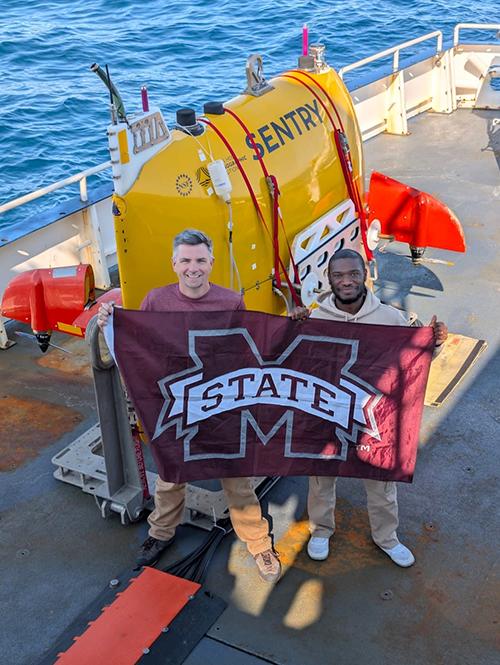
MSU Department of Geosciences Professor Adam Skarke and Ramon Kalski, a Ph.D. student in earth and atmospheric sciences from Pascagoula, are joining an expedition aboard the U.S. Navy research vessel Atlantis through late September as it inspects areas of the seafloor where large amounts of methane gas emerge. The team’s goal is to determine where methane originates, what controls its movement, how much enters the ocean and how long the emissions have occurred.
“The results of this work will give us information that helps us better understand our shared ocean and atmosphere, including things that impact our lives like fisheries, energy resources and climate,” Skarke said.
The team will travel 80 miles off the Virginia coast and use the ship’s human-occupied, deep-sea vehicle Alvin to descend almost 4,000 feet to collect sediment, rock, water and gas samples, and use video cameras and specialized instruments to measure methane discharge at study sites.
Methane is a potent greenhouse gas, and natural emissions from the seafloor could represent a significant source not fully accounted for in current ocean and climate models. It also alters seawater chemistry and can influence deep-sea ecosystems. Methane seeps occur throughout the world, including the Gulf. Findings from Skarke’s expedition could help scientists better understand seafloor processes that affect the Gulf, climate and marine resources.
The expedition is part of a $3 million National Science Foundation-funded project involving researchers from MSU, the University of Georgia, Texas A&M University and the University of Delaware. The project, which began in 2024, includes $419,190 awarded to MSU.
Joining Skarke as principal investigators are UGA’s Mandy Joye, TAMU’s Davide Oppo and UD’s Sunita Shah Walter.
This expedition is the third phase of the research project. During the team’s first two expeditions, researchers mapped the seafloor and subsurface, discovering methane discharge sites were 15 times more abundant than earlier mapping had indicated.
A fourth expedition planned for 2027 will collect deep sediment cores to investigate how methane moves through the seafloor and how its emissions have changed over time.
For more details about MSU’s College of Arts and Sciences or the Department of Geosciences, visit www.cas.msstate.edu or www.geosciences.msstate.edu.
Mississippi State University is taking care of what matters. Learn more at www.msstate.edu.